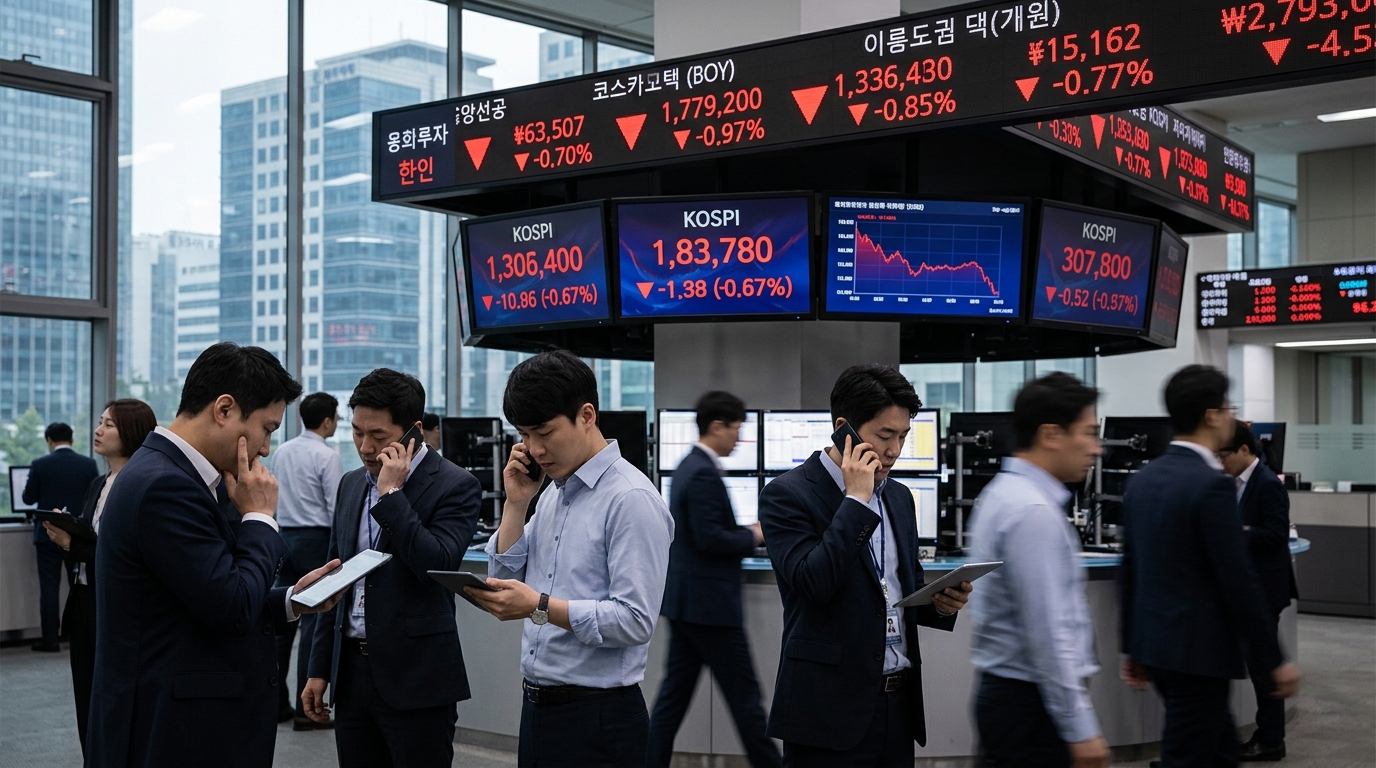
Before New York trades a single share Thursday, the damage is already logged on two continents. The KOSPI ended down 7.57% at 5,554.22, extending a losing streak to a seventh consecutive session, the longest since September 2024. During the session the index fell more than 9% to an intraday low of 5,450.81 before paring losses toward the close. Stage-one circuit breakers were triggered in succession on the KOSPI and KOSDAQ shortly after noon, with the KOSPI down 8.00% at the halt and the KOSDAQ off 8.01%.
Foreign investors led the selling, offloading shares worth 3.62 trillion won, about $2.68 billion, on the bourse. J.P. Morgan’s head of Korea equity strategy, Mixo Das, said the market is “struggling to find a new buyer” after buyback programs at Samsung and SK Hynix have run their course. That framing matters for US traders: the marginal buyer that supported Korean chips through the summer is no longer present.
SK Hynix sank 11.06% to 1.26 million won, while Samsung Electronics plunged 9.48% to 210,000 won. Losses spread across technology, with Samsung Electro-Mechanics plunging 15.36% and SK Square shedding 10.21%. In Tokyo, the picture was equally concentrated. The Nikkei ended down 4.9% at 64,425.95, while the broader Topix fell 2.4%. Advantest and Tokyo Electron fell 15% and 7.8%, respectively, with SoftBank Group dropping 9.3%. Kioxia fell more than 13%.
The trigger was not conjured in Seoul or Tokyo. US September CPI came in above expectations, fueling concern over further rate hikes, and all three major US indices closed lower Wednesday, with the Philadelphia Semiconductor Index tumbling 4.3%. But the deeper wound was credit-driven. CoreWeave’s bonds plunged to levels that typically indicate distress, catching the attention of Silicon Valley leaders including Elon Musk. CoreWeave’s 9.625% 2032 notes yielded about 14.8% and its 9.75% 2031 notes around 14.9%, while Oracle shares fell nearly 7% and Dell roughly 11%. The read-through: credit markets are pricing the cost of building AI infrastructure higher, and that flows directly into the revenue assumptions for every memory and chip equipment maker in the world.
Twenty of the most valuable global AI and semiconductor stocks have shed more than $1 trillion so far this week, as interest rates, AI financing concerns, and intensifying competition weighed on sentiment. US names did not escape Wednesday. Meta closed down 3.27%, Nvidia 3.16%, and both Amazon and Alphabet fell 1.74%. In premarket Thursday, Nvidia was down about 1.3%, Micron about 4%, AMD about 1.9%, CoreWeave about 4.5%, and Oracle was modestly lower.
The Trading Plan
The key question for Thursday is how much of the Asian session panic is simply Wednesday’s US losses recycled through a more volatile market, and how much represents new information. The CoreWeave credit story is genuinely new. Hotter US inflation supplied the immediate catalyst, but the deeper concern is AI economics: whether the companies funding the infrastructure boom can sustain spending at current levels. Concerns around global memory chip oversupply as early as 2029, as manufacturers ramp up production capacity, are also weighing on sentiment.
For US chip names, Nvidia and Micron already absorbed meaningful losses Wednesday. The risk is a second leg if early US volume confirms institutional distribution rather than retail panic selling. Watch whether Nvidia holds above its 50-day moving average at the open. A close below that level on heavy volume would shift the technical outlook from pullback to breakdown. Micron’s leverage to HBM demand makes it the most direct proxy for what is happening to Samsung and SK Hynix; if foreign funds are rotating out of memory globally, Micron does not decouple. Oracle, as a major AI infrastructure borrower, deserves specific attention given Wednesday’s nearly 7% drop alongside the CoreWeave credit move.
As Mirae Asset’s Seo Sang-young put it, the market is “reacting sensitively to whether capital raising will be sustainable and whether massive infrastructure investment will lead to real income, rather than revenue growth itself in AI services.” That is the question Thursday’s US session has to answer. Until credit spreads on AI infrastructure debt stop widening, every rally in chip names is a candidate for distribution, not accumulation.
 Rising Star Stocks