Tim Plaehn here.
Most dividend stocks only pay you once every three months.
But with this little-known $15 gold investment, you could get paid every Friday.
In one month, those weekly payments could add up to $1,127.
I call them Friday Golden Payments.
See here how to collect gold income every Friday.
To your income,
Tim Plaehn
Chief Income Strategist, Investors Alley
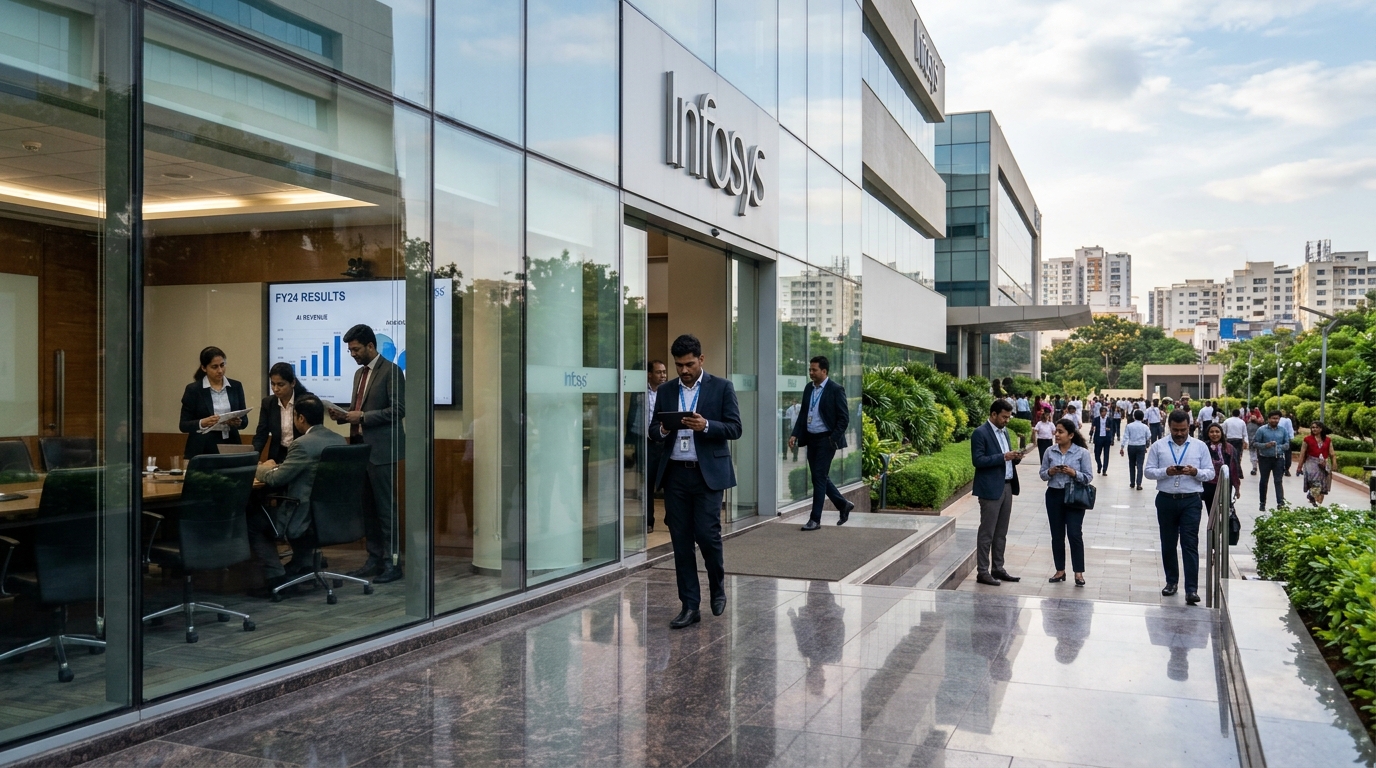
Infosys Reports Today. Its 8% AI Revenue Share Will Tell You Everything.
Indian IT just had one of those weeks that demands a reckoning. The Nifty IT index surged 11.7% in the five trading days ending October 16, its biggest weekly gain since April 2008. Infosys climbed 13.5% in that stretch. TCS added 14.3%. Markets were essentially voting that the AI infrastructure overbuild in the United States is good news for Bangalore.
That vote gets tested this afternoon, when Infosys reports Q2 FY27 results.
What the Numbers Going In Actually Say
The Q1 FY27 filing told a story in two halves. Total revenue came in at $5,082 million, up just 2.4% year on year in constant currency terms. Operating margin held at 21.1%. Large deal wins reached $3.6 billion, with 61% classified as net new business. Those are solid execution numbers for a business in a slow-demand environment.
The other half: Infosys cut the top end of its FY27 revenue guidance from 3.5% to 3.0%, narrowing the range to 1.5-3.0%. That revision happened one quarter in. It is not a catastrophe, but it signals that the firm itself does not believe the demand recovery is secured.
Heading into today, Bloomberg consensus puts Q2 net profit at roughly Rs 7,904 crore and sales near Rs 49,108 crore. Most brokerages are modeling 1.1-1.5% sequential constant-currency revenue growth. Emkay Global expects another guidance trim, to 1.5-2.5% for the full year. Kotak Institutional Equities has flagged what it calls AI-led deflation as the structural drag worth watching in management commentary.
The 8.2% Question
Here is the number that matters most: AI revenues were about 8% of Infosys total revenue in Q1, and CEO Salil Parekh said that figure has been growing at double-digit rates quarter on quarter for several consecutive quarters. In absolute terms, that puts AI revenue somewhere above $400 million quarterly.
Compare that to the competition reporting this season. TCS said its annualized AI revenue crossed $3.1 billion in Q2, clearing 10% of total revenue. HCLTech reported advanced AI revenue of $219 million in the quarter, up 78% year on year in constant currency. Both peers are now listing an AI revenue figure alongside headline numbers as though it were a primary metric.
The critical question for Infosys today is not whether AI revenue is growing. It almost certainly is. The question is whether that growth is adding to total revenue or simply replacing work that used to get billed under a different category. Kotak’s framing of AI-led deflation captures this precisely: automation tools that Infosys deploys for clients can compress the billable hours on the same engagement. Win more AI contracts, bill fewer hours. The math can turn against you.
Strategic Positioning
Infosys has structured its AI play around the Topaz platform, which it describes as covering six service areas: AI strategy and engineering, data, process, legacy modernization, physical AI and trust. It has established partnerships with Anthropic, OpenAI, Google Gemini, NVIDIA, Microsoft and AWS. The company has said it has deployed GitHub Copilot across several thousands of engineers.
Infosys’s enterprise AI partners are themselves racing to turn infrastructure spend into billable products. Microsoft’s rebuilt Copilot platform shows how a hyperscaler converts years of AI capital expenditure into enterprise software revenue.
The services model Infosys runs, selling skilled labor at scale to large enterprises, is simultaneously well positioned and vulnerable in an AI transition. Well positioned because enterprise AI adoption requires exactly the kind of system integration, change management and data infrastructure work that Infosys does. Vulnerable because AI productivity gains could shrink the labor component of each engagement faster than new project volumes can replace it.
IBM faces the same structural tension from the other side of the table. IBM Consulting is building a delivery layer above frontier models to capture enterprise AI work that pure software cannot reach.
Risks Worth Naming
Three things could make today’s numbers look worse than the headline suggests. First, a further guidance cut below 1.5% CC growth would signal that the Q2 softness in retail and communications verticals is spreading rather than contained. Second, TCV coming in below $2.5 billion would raise questions about deal momentum heading into a typically strong second half. Third, management commentary on furlough intensity and 2027 client budget discussions matters as much as the reported quarter; analysts at Business Standard noted that watching demand outlook language is now as important as watching reported revenue.
There is also a leadership variable. CEO-designate Ashiss Kumar Dash is expected to feature in today’s call as the firm manages a transition. Investors will listen for whether his commentary signals strategic continuity or an intention to reprioritize the AI services mix.
What the Rally Actually Bought
The 11.7% sector surge was driven partly by better-than-expected results from peers and partly by global investors rotating away from crowded AI infrastructure positions in US equities. The Nasdaq fell 4.5% in the same week. That rotation is real, but it is not the same thing as a fundamental demand recovery in IT services.
Analysts at Choice Institutional Equities have noted that stronger organic growth and rising AI revenue are both needed for a broader recovery to hold. The rally was a permission slip, not a verdict. Infosys today delivers the evidence for or against it.
At about 8% of revenue and growing, Infosys’s AI business may be approaching the threshold where it changes the growth trajectory rather than just the growth story. Whether Q2 confirms that momentum, or whether AI-led deflation in legacy work is quietly eating the gains, is what markets will be pricing from this afternoon onward.
 Rising Star Stocks