Here is the question Boeing investors need to answer today: does a company in genuine recovery mode let a single small supplier idle its 777 freighter line for two months without anyone noticing until a Reuters exclusive lands four days before earnings?
This morning’s Q3 report delivered the numbers the turnaround needed. Revenue beat Wall Street consensus, and Boeing hit positive free cash flow, a significant milestone for CEO Kelly Ortberg given that Q3 included a $700 million payment tied to the company’s Justice Department settlement. Management had guided Q3 free cash flow to a positive low hundreds of millions despite that DOJ payment, and held the full-year outlook at $1 billion to $3 billion. Clearing that bar while absorbing such a large cash outflow is real progress.
The 737 MAX 10 certification is the other headline worth lingering on. Nine years after its launch at the Paris Air Show and more than six years after its original service-entry target, the 737 MAX 10 received its FAA amended type certificate on October 20. The FAA also updated Boeing’s production authorization, meaning Boeing can now move from finished-but-parked airplanes to deliveries as it completes customer-specific work and final delivery steps. Customers have ordered about 1,555 of the type, roughly 30 percent of Boeing’s unfilled 737 MAX orders. That is not a marginal win. The 737-10 competes directly with the Airbus A321neo, and the backlog behind it represents one of the clearest paths Boeing has to sustained cash generation through the rest of the decade.
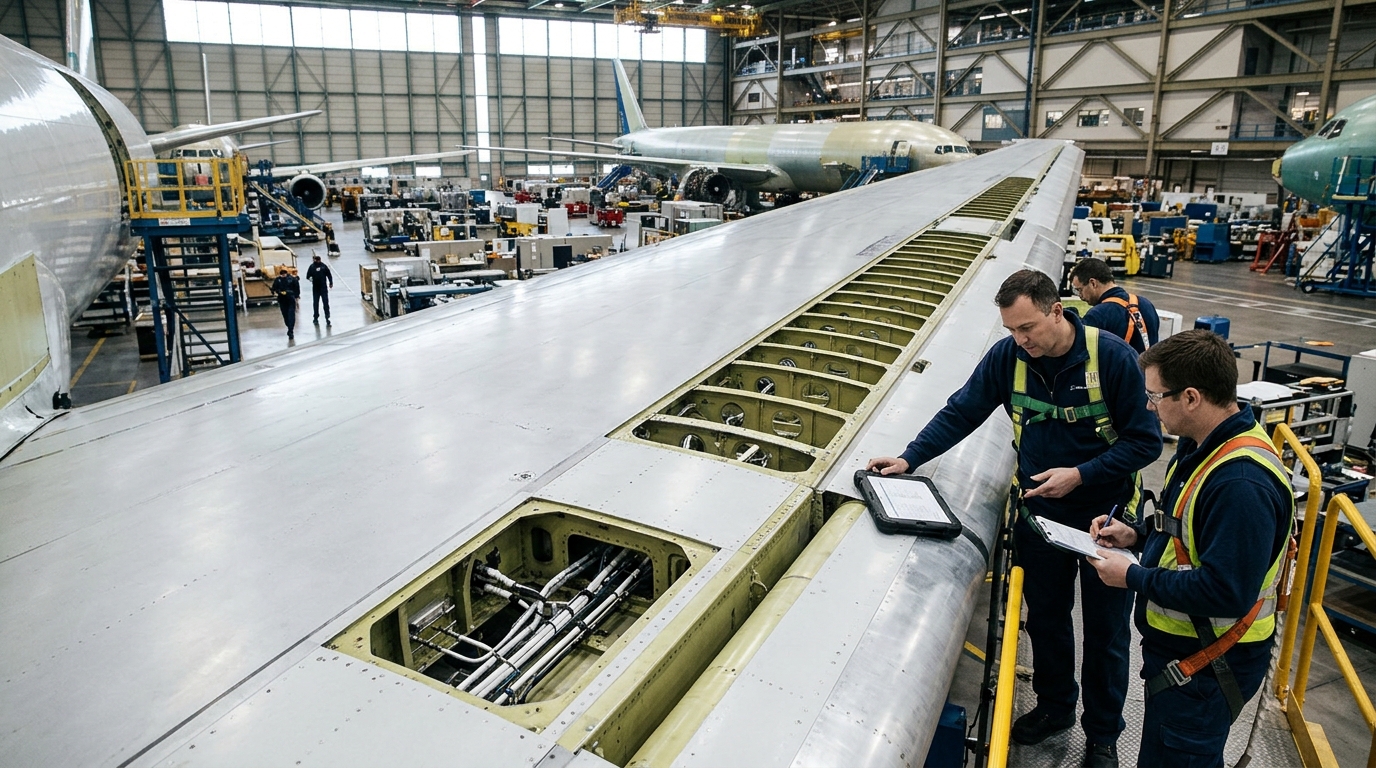
But the freighter situation is harder to wave away. Boeing filed a complaint in August alleging that supplier Vaero had stopped delivering a critical wing component known as the trailing-edge rib kit, stalling work at the Everett, Washington, wing-production facility that supports the 777 freighter and 767 programs. Boeing said in the complaint that the trailing-edge rib kit was an “indispensable” part and Vaero was the sole supplier. Although the companies reached a settlement in late September, production of the 777 freighter has yet to resume. The dispute also disrupted production of the 767, a widebody cargo and military aircraft. That 767 line includes the KC-46A Pegasus tanker, a program with direct defense revenue implications.
Despite the settlement reached in late September, production has not yet resumed, casting uncertainty on delivery schedules and cash flow management. Boeing is now attempting to bring the part in-house. Boeing has delivered 21 777 freighters this year, and a few more with wings built before the dispute could still ship by year-end. That puts freighter revenue at risk in Q4, which is already the quarter doing the heavy lifting to meet the $1 to $3 billion full-year free cash flow target. Reaching that annual target could require approximately $1.5 billion to $3.7 billion in Q4, depending on the Q3 result.
The bull case rests on three pillars: the 737 production ramp toward 47 per month with the new North Line in Everett coming online, the MAX 10 finally opening a direct challenge to the A321neo at scale, and two consecutive quarters of positive free cash flow proving the financial model is no longer purely theoretical. Free cash flow turned positive at $631 million in Q2 from a negative $200 million a year earlier, and total backlog reached a record $715 billion at the end of Q2. Ortberg inherited a company on fire; the smoke is clearing.
The bear case is simpler. Boeing is a company that cannot afford a single-supplier failure to become a two-month secret. The prolonged disruption highlights the fragility of aerospace supply chains, showing how a dispute involving one supplier can halt production of aircraft that remain in strong demand. If the 777 freighter line stays dark deep into Q4, the company’s full-year cash flow guidance comes under genuine pressure. Airbus reports on October 28. Every quarter Boeing stumbles, Airbus extends the gap in widebody deliveries it has spent three years building.
Watch two things on the conference call at 10:30 a.m. ET. First, whether Ortberg gives a firm date for 777 freighter production resuming, not a settlement summary. Second, whether the full-year cash flow guidance band narrows or holds. A held range with a supplier line still idle is a very different signal than one backed by a restart date and a credible Q4 delivery schedule.
Boeing’s recovery is not fake. But turnarounds that depend on flawless execution cannot afford a two-month blind spot in Everett. That is what today’s report ultimately has to answer for.
 Rising Star Stocks