Editor’s Note: Over the past 20 years, Matt McCall has written up 50 stocks before they soared tenfold or more. Today he’s giving away a favorite new pick, free… at the center of what Dr. Mark Skousen calls “the most dangerous boom in history.” Click here to get the full details or read more below.
Dear Reader,
I recently sat down with Dr. Mark Skousen…
And he told me something that contradicts just about EVERYTHING we’ve been hearing about the stock market.
In short…
He says an astounding amount of money could flood into the markets in the years ahead.
We’re talking $60 trillion in new wealth up for grabs between now and 2029.
In my career, I’ve found 50 stocks before they soared tenfold or more.
(Most investors are lucky to see one ten-bagger in their lifetime.)
And I can tell you flat out…
I’ve never been more excited for what’s coming than I am right now.
See why here!
And as a special thank you for watching, you’ll get one of my favorite picks.
Regards,
Matt McCall
Editor, McCall’s Innovation Report
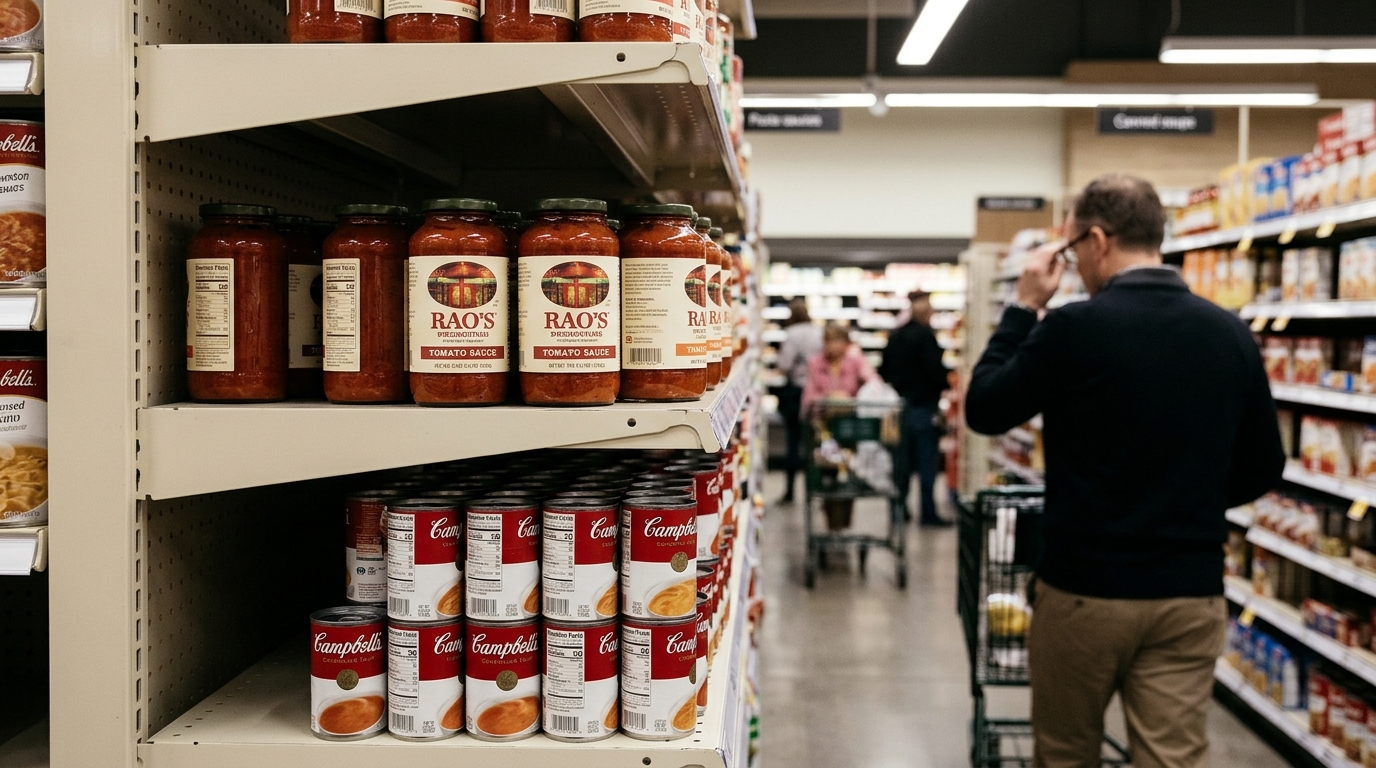
Rao’s Hit $1 Billion. CPB Is Trading Like It Didn’t.
Consumer staples stocks are supposed to be boring. Campbell’s (NASDAQ: CPB) has been anything but. Shares are down more than 20% over the past 52 weeks, the dividend was reset 36% to $0.25 per quarter effective September 3, 2026, and fiscal 2027 guidance landed below what Wall Street expected. Jefferies called next year “a difficult year.” Multiple firms cut price targets to $20 or below.
The bear case is real. Full-year fiscal 2026 revenue fell to $9.74 billion, down nearly 5%. Adjusted EPS dropped 27% to $2.17. The Snacks segment, which includes Goldfish, Cape Cod, and Kettle Brand, was responsible for most of the damage: operating earnings there fell 28% for the year as tariff-related input costs, volume weakness, and an inefficient manufacturing network compounded each other.
But the selloff has blurred a distinction that matters. The Snacks business is broken. The Meals & Beverages division is not.
What Rao’s Actually Became
Rao’s crossed $1 billion in trailing twelve-month net sales during Q2 fiscal 2026, making it Campbell’s fourth billion-dollar brand alongside Campbell’s, Goldfish, and Pepperidge Farm. Consumption of Rao’s sauce rose 8.9% in Q4 and 9.4% for the full fiscal year. Performance outside of sauce, which includes soup, pasta, and frozen, grew 17.7% for the year. Household penetration was not disclosed in the company’s fiscal 2026 materials, but management has emphasized that it remains well below legacy category peers.
Campbell’s locked in that growth engine in May 2026 by closing a $286 million deal for a 49% stake in La Regina, the Italian producer based in Scafati that has made every jar of Rao’s tomato-based sauce since 1993. That is not a sentimental transaction. It is supply chain defense for the company’s clearest volume growth driver.
The Growth Office and the AI Bet
What has gone largely unnoticed in the selloff is the operational infrastructure Campbell’s began building at the start of fiscal 2026. Management established what it calls the Growth Office, a centralized function covering insights and analytics, consumer experience, innovation, R&D, and revenue growth management. The earnings call described it as the mechanism for “rapidly turning consumer insights into relevant food and brands.”
The practical results so far include one of the company’s strongest innovation pipelines in several years and the removal of artificial colors from its foods and beverages, which CEO Mick Beekhuizen said would be completed starting in the second half of fiscal 2026. For fiscal 2027, the company said AI-enabled platforms will be part of a media mix that represents roughly 85% of its working media budget, with digital, social, influencer, and e-commerce channels absorbing the majority of spend. Social and search data already shaped the decision to launch Swanson’s first ramen broth, targeting at-home cooks gravitating toward global flavor profiles.
The Math That Could Matter
Fiscal 2027 guidance is weak: net sales expected to fall 2% to 4%, adjusted EPS of $1.65 to $1.80. The forward price-to-earnings multiple at $19 sits around 11 times. That is cheap for a portfolio that includes a billion-dollar premium brand compounding at nearly 10% annual consumption growth.
The $500 million enterprise cost savings program, targeting delivery by the end of fiscal 2030, is the other side of the ledger. Combined with potato chip network consolidation that has been years in the making, including the planned Hyannis facility closure, the fixed-cost base is shrinking.
Fiscal 2027 may well be the trough. If Rao’s continues expanding into soup, pasta, and frozen categories while the Growth Office accelerates its data-driven product pipeline, the gap between what CPB is worth and where it trades could close faster than the consensus expects. Worth watching.
 Rising Star Stocks