
September 27, 2026
Bonus Content: Rocket Lab’s $2.36B Backlog Is the LEO Race’s Best Signal

America’s Emergency Oil Reserve Just Hit A 44 Year Low
It is 40.6% full. Here is why that reaches your grocery bill and your retirement account.
284.6M
BARRELS REMAINING
Week ending September 18, 2026. EIA Weekly Petroleum Status Report, released September 21.
The Strategic Petroleum Reserve is the country’s emergency crude stockpile. Its job is to soak up a supply shock before that shock reaches the price you pay.
Federal data now puts it at 289.7 million barrels, roughly 40.6% of its 714 million barrel authorized capacity. That is the lowest level since 1982.
The short version of how it got there:
✔ Before February 28 of this year, the reserve held roughly 415 million barrels.
✔ After the Strait of Hormuz was disrupted, a chokepoint carrying close to 20% of global oil supply, President Trump authorized a 172 million barrel release in March.
✔ That release was part of a coordinated international effort, with IEA member nations collectively committing 400 million barrels. Reported as the largest emergency stock mobilization the agency has ever run.
✔ The reserve has kept draining since. It fell another 3.7 million barrels in the most recent reported week alone.
One analyst note circulated by CNBC put it bluntly, calling this another inflation impulse and saying the country effectively has no strategic reserve left to speak of.
That’s rhetoric. 289.7 million barrels is still a real stockpile, and it sits above the statutory minimum of 252.4 million barrels set under the Energy Policy and Conservation Act. Anyone telling you the tank is empty is overselling it.
But the cushion is thinner than it has been in more than four decades, and thin cushions matter for one reason.
Energy feeds into nearly everything you buy, from groceries and freight to utilities and building materials. When oil moves and there’s less reserve on hand to blunt it, more of that move ends up on the shelf. Gasoline has been running around $4.08 a gallon in recent reporting.
Inflation doesn’t arrive as an event. It works as a slow subtraction from every dollar you’ve already put away.
A retirement account does not need a crash to lose ground. It only needs prices to keep rising faster than the account grows.
This is the kind of stretch gold has historically been held for. It promises nothing about returns. It’s savings held outside the currency and outside the paper system.
Central banks seem to think so too. The World Gold Council reported they bought a net 288.9 tonnes of gold in the second quarter of this year, up 62% from a year earlier.
The tax code allows eligible IRA, 401(k), TSP, and 403(b) savings to be diversified into physical gold and silver through a properly structured self directed IRA, generally without triggering a taxable distribution when the transfer is handled correctly.
Send me the FREE Precious Metals Retirement Guide

Inside your free guide:
✔ How energy shocks have historically fed into consumer inflation, and how quickly.
✔ How gold has behaved during past inflationary stretches.
✔ How a Gold IRA generally works, and how you may be eligible to move a portion of an existing IRA, 401(k), TSP, or 403(b) into physical metals.
✔ How physical metals can help diversify savings outside the paper system.
✔ A simple, conservative way to get started.
Or call 1-888-691-8238 to speak with a precious metals specialist.
The reserve was the cushion. There’s a lot less of it now.
Rocket Lab’s $2.36B Backlog Is the LEO Race’s Best Signal
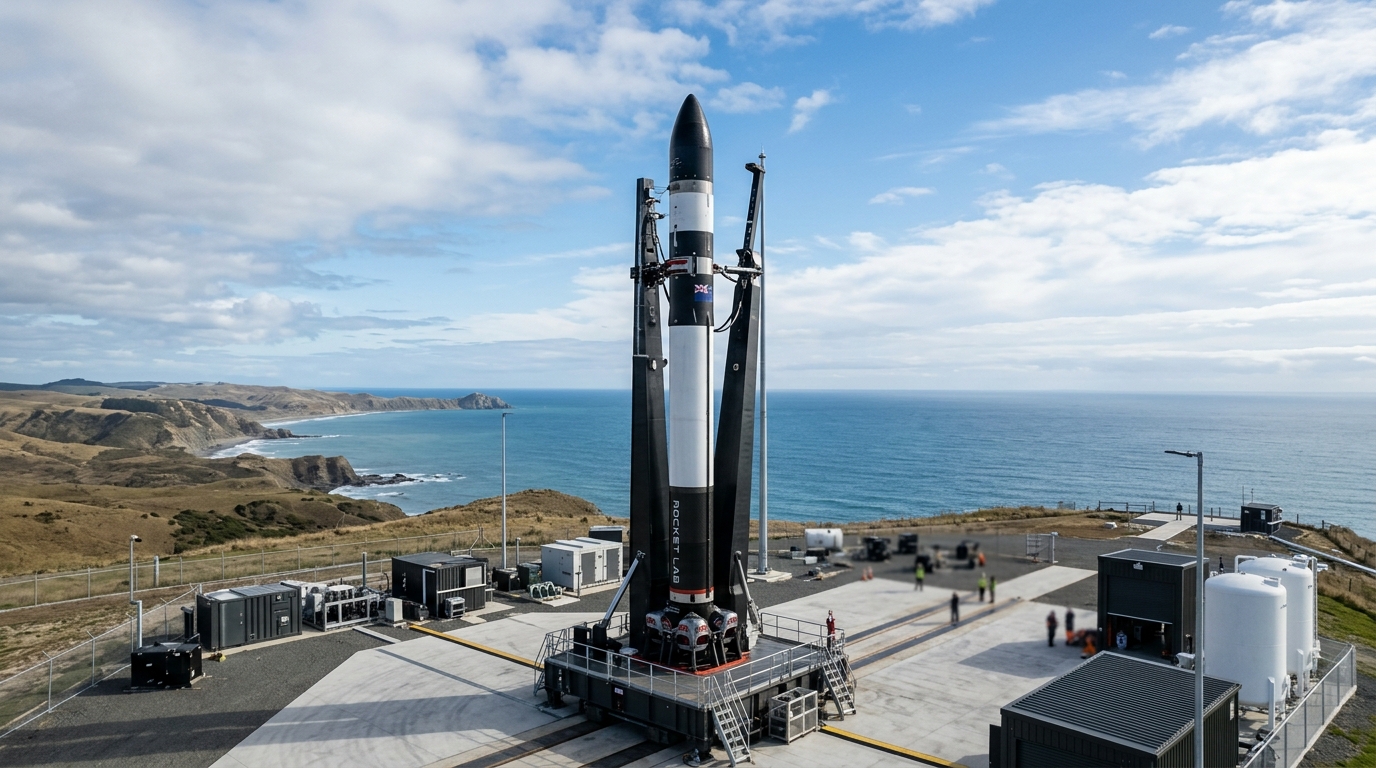
The satellite fleet war is not being lost in orbit. It is being lost on the launchpad.
Amazon bought more than 80 rockets to build its LEO constellation and called it the largest commercial launch procurement in history, part of an investment Amazon has described as more than $10 billion. Even with that, it requested an FCC waiver this past June because it could not get enough satellites off the ground fast enough. By late June, Amazon itself said it was likely to end up close to 400 satellites in orbit by July 30, 2026 against an interim milestone of 1,616 satellites. Blue Origin’s New Glenn suffered a major anomaly on May 28, 2026 during a pad hotfire test that destroyed the vehicle and damaged the pad. Atlas V is in its final stretch. Ariane 6 is still ramping. Falcon 9 manifests are crowded. Every launch provider Amazon leaned on hit a wall at once.
That is the constraint nobody discusses loudly enough: rocket supply, not satellite supply.
SpaceX’s Structural Edge
SpaceX does not have this problem because it owns the rocket. In the first six months of 2026, SpaceX deployed 1,589 Starlink satellites into LEO, ahead of 2025’s record pace over the same window. It filed in January to eventually fly up to one million satellites for an orbital data center concept. Starlink reported more than 10 million subscribers by February, up from 4.6 million at year-end 2024. The vertical integration advantage is structural: no manifest conflicts, no third-party delays.
For everyone else, the launch queue is now the competitive moat that matters most. Which is where Rocket Lab looks increasingly well-positioned.
The Numbers Behind the Backlog
In Q2 2026, Rocket Lab posted record quarterly revenue of $234 million, up 62% year over year, and a record backlog of $2.36 billion, up 137% year over year. In Q1 alone, the company said it sold more launches than it flew missions across all of 2025. Its total launch backlog now exceeds 90 launches. Electron has completed more than 90 missions, and Rocket Lab has described Electron as the second most frequently launched orbital rocket in 2025.
Then there is the Iridium deal. On June 29, 2026, Rocket Lab agreed to acquire Iridium Communications for roughly $8 billion in enterprise value. In the last week, Iridium disclosed that its stockholders voted to approve the transaction. The logic is vertical integration: Rocket Lab would be positioned to design, build, launch, and operate a constellation, tightening the same kind of loop Starlink uses to compound its lead.
The Risk That Still Matters
The Neutron medium-lift rocket is the near-term risk. It has not flown and is behind schedule. A $397 million U.S. Space Force contract is specifically tied to Rocket Lab building Flatellite spacecraft and launching them on Neutron. Delays stretch the conversion timeline on a portion of that $2.36 billion backlog.
Big Picture
TrendForce projects the global satellite launch market will reach $40.4 billion by 2028, driven by Starlink V3 and competing constellation programs. Constellations are multiplying. Rockets remain scarce. Rocket Lab sits at that intersection with a backlog, a pending acquisition, and a compounding launch rate. Neutron’s debut may be the only catalyst separating the current valuation from where the market is heading.
 Rising Star Stocks