Editor’s Note: With the market in turmoil, one of America’s best connected financial insiders (who called the 2000 and 2008 crises) is stepping forward with a warning everyone in our country needs to hear. Click here to get it or read more below.
Dear Reader,
A millionaire Wall Street insider just issued a dramatic new warning – and every American with money in the stock market needs to hear it today.
After running his own $200 million hedge fund firm, this Wall Street legend saw the Twin Towers fall on 9/11… the banks collapse in 2008… and the economy grind to a halt in 2020…
But now, he’s warning:
Whitney Tilson, who famously called the Tech Wreck in 2000, has a long history of eerily accurate predictions – CNBC even gave him a nickname he never asked for: “The Prophet.”
His appearance on 60 Minutes exposing the 2008 financial crisis even won an Emmy.
But he says what’s happening in America today is more dangerous than anything he’s seen before.
He’s warning millions of Americans could soon be blindsided by a permanent change coming to our country, which will be far more wide-reaching than a stock market crash or banking collapse.
Just look at what’s happening inside Gartner. For decades, it’s been at the heart of America’s white-collar economy – full of staff from top-tier Ivy League schools.
It should be one of our country’s most stable firms…
And yet, in the last year, it’s collapsed by more than 60%.
That’s why Tilson says it’s now critical you move your money today – because the next part of this story is going to make America unrecognizable.
In fact, he’s just agreed to reveal exactly where to put your money today – a new investment research vehicle his team spent years developing, ready for this moment.
Get the full details right here, while you still can.
Regards,
Matt Weinschenk
Publisher and Director of Research, Stansberry Research
P.S. Gartner isn’t the only white-collar firm in trouble. The world’s most powerful “knowledge” work firms are getting destroyed. Consulting firms. Insurance analytics. Software stocks.
Morningstar. Duolingo. Verisk. Accenture. They’re all in freefall. Duolingo has already collapsed as much as 75% in a year.
These aren’t just random examples. They’re connected. They’re warning signs. And ignoring them will be catastrophic.
Walmart’s Ad Business Is Now One-Third of Profit
Walmart has been running a second business inside its first one for years. Most investors still price it like a grocer.
The Numbers Demand Attention
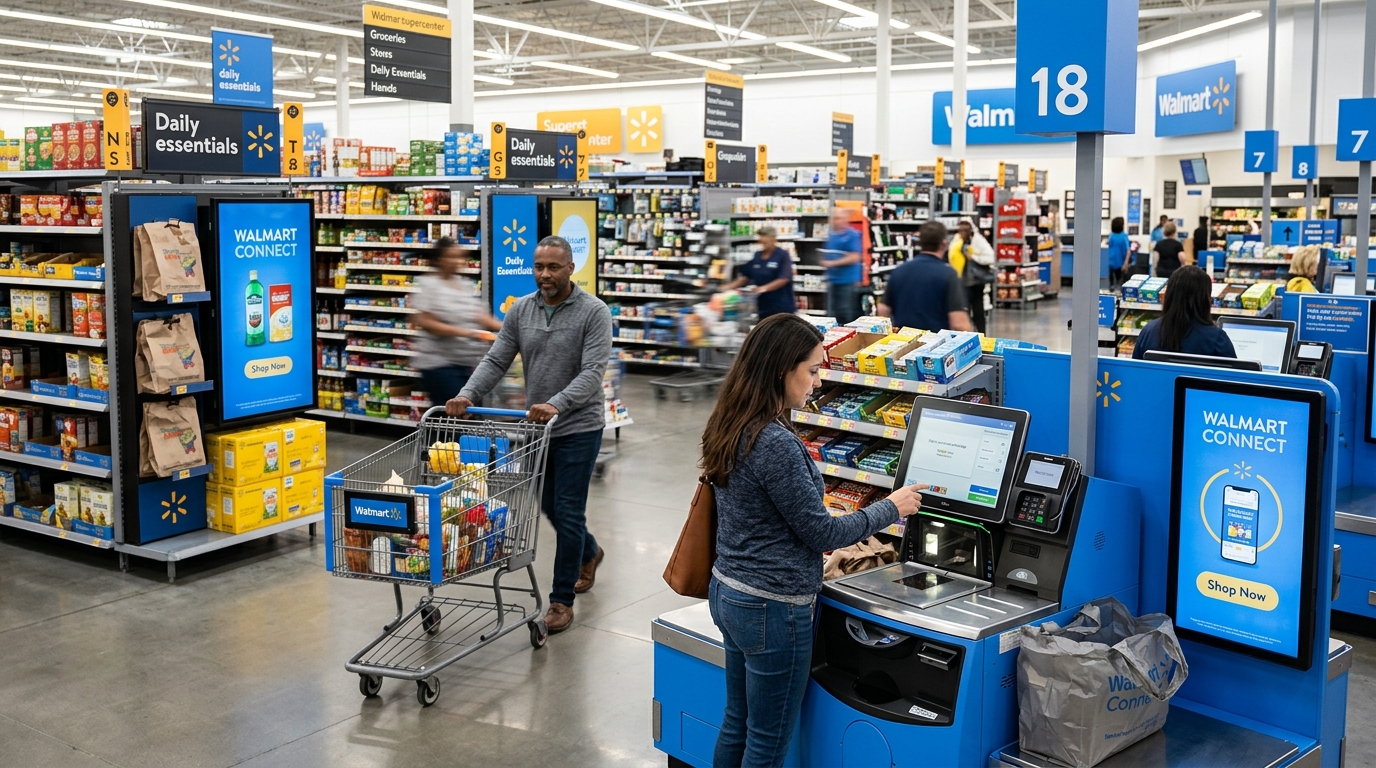
When Walmart reported Q2 FY27 results on August 20, 2026, Walmart Connect in the U.S. grew 43% excluding VIZIO, with total advertising across the company up 38%. That is not a rounding error in a $706.4 billion revenue business. U.S. operating income rose 20.6% to $8.1 billion, and Walmart credited an improved business mix from digital advertising as part of what drove gross profit rate expansion of 158 basis points.
The profit composition tells the sharper story. On the Q4 FY26 earnings call on February 19, 2026, CFO John David Rainey told investors that nearly a third of quarterly operating income came from advertising and membership income. What changed between then and now is that the delivery channel has become the engine feeding that ad inventory.
Why Delivery Traffic Is Different
Marketplace sales grew nearly 50% in Q1 FY27, the best performance in ten quarters, while more than 36% of store-fulfilled deliveries were delivered in under three hours. Every one of those checkout sessions is a monetizable moment. A customer adding groceries and household goods to a delivery cart sits in that funnel longer, sees more sponsored placements, and converts at a higher rate than a browser.
Walmart CEO John Furner said on the Q2 FY27 earnings call that customers using Sparky, Walmart’s AI shopping assistant, are up 70% year over year, and those shoppers spend 40% more per order than those who don’t use it. Sparky is not a convenience feature. Walmart’s integration of advertising formats within Sparky reflects a strategy to maintain control over customer relationships and first-party data monetization as AI shopping experiences expand.
The Gap That Frames the Opportunity
Walmart Connect’s advertising revenue as a percentage of gross merchandise value remains in the mid-to-low single digits, which management has described as middle of the pack relative to competitors, implying substantial room to grow monetization against the underlying commerce volume flowing through its platforms.
Walmart’s global advertising business grew 46% in FY26. Yet Amazon’s advertising services net sales were $56.2 billion in 2024, while Walmart’s $6.4 billion represents a fraction of that figure but is growing faster, particularly in the U.S. onsite segment.
The Risk Worth Watching
Retail media monetization has a ceiling tied to shopper tolerance. Overloading sponsored placements risks degrading the search experience that drives conversion in the first place. Walmart has said it closed its acquisition of Vibe.co on August 4, 2026, adding a self-serve connected TV platform inside Walmart Connect; management expects Vibe to widen access for small and medium advertisers through self-service tools, but the integration timeline and how Vibe inventory connects to Walmart’s first-party data remain unspecified.
The Bigger Picture
E-commerce creates digital activity, advertising monetizes it at higher margins, and the important number may eventually be less how fast Walmart Connect grows than how much advertising changes the profitability of Walmart itself. That reframing is worth sitting with. WMT may be worth watching less as a retailer catching up on digital and more as a retail media platform that happens to own the distribution network its ads run on.
 Rising Star Stocks