
The debate inside energy investment committees this morning is not about whether BP, ExxonMobil, and Chevron are profitable. They obviously are. The debate is whether the profits represent durable earnings power or a geopolitical accident that deserves no multiple at all.
The Big Question
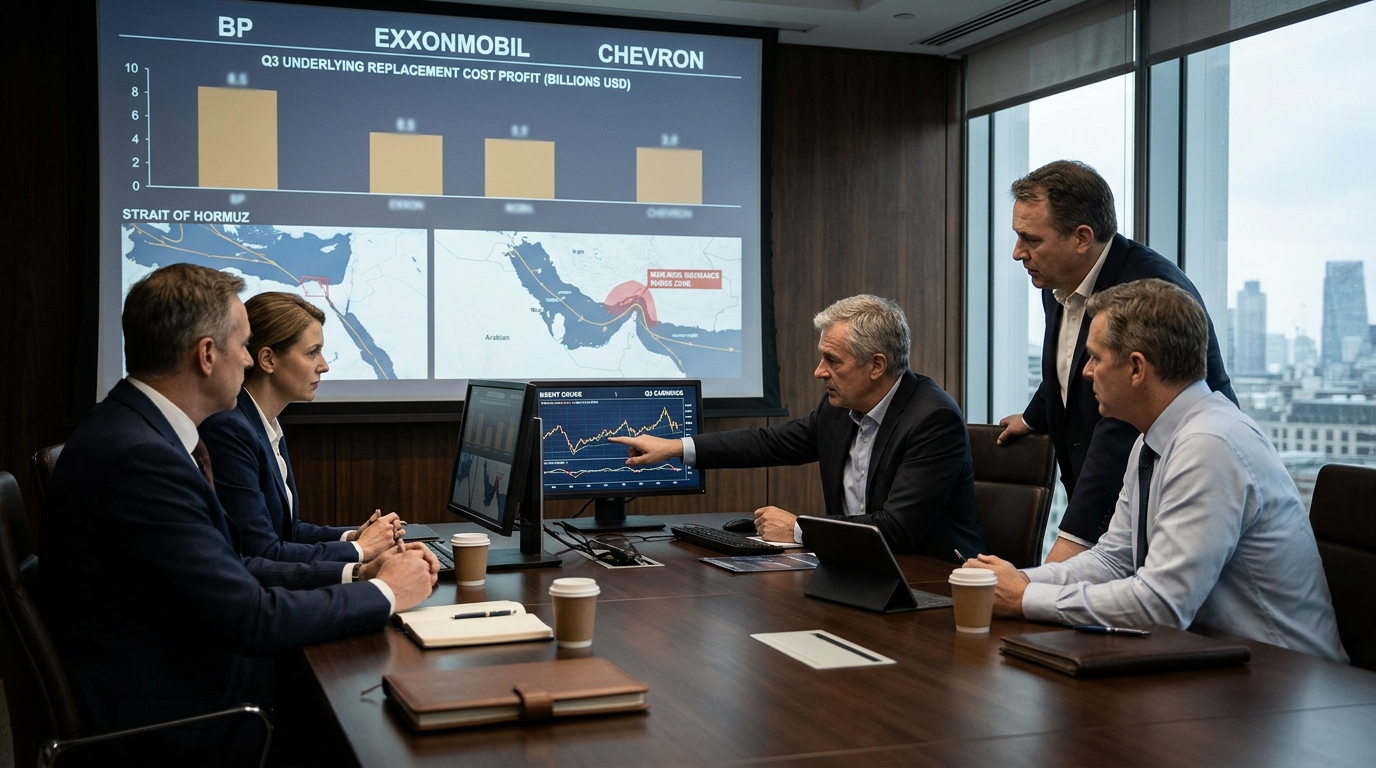
BP set the tone before the European open. BP’s Q3 2026 underlying replacement cost profit came in at $8.5 billion, significantly exceeding analyst expectations of $7.33 billion and sharply improving from $2.2 billion in Q3 2025. Operating cash flow reached $14.8 billion, and net debt fell to $13.9 billion, hitting the company’s net-debt target earlier than planned. ExxonMobil and Chevron then reported before the US open. Analysts had expected ExxonMobil to post EPS of $4.03 and revenue of about $106 billion, boosted by higher refining margins. Chevron was expected to post earnings of $4.86 per share on revenue of $61.33 billion.
Why Wall Street Cares
Brent crude’s December contract was trading at $116.08 a barrel this morning, on track for a gain of nearly 11 percent in October, its fourth straight monthly rise. That is not a commodity market. That is a war market. The closure of the Strait of Hormuz, through which roughly a fifth of globally traded oil moves, and attacks tied to the conflict around Iran and Gulf energy infrastructure produced a large disruption in global oil supplies. Eight major oil producers earned almost $93 billion between April and June 2026, nearly double their combined profit in the same quarter of 2025. Q3 looks larger still.
The bull case is straightforward: these companies are generating cash at a rate that justifies the run in their share prices. ExxonMobil flagged in mid-October that higher refining margins were expected to boost third-quarter Energy Products earnings by $4.5 billion compared with the second quarter. Even with the preliminary filing pointing to a $1.3 billion sequential upstream headwind from lower liquids prices, the refining tailwind more than covers the gap.
The Bear Case
The counterargument is sharper than it sounds. JPMorgan’s pricing model has put Brent’s fair value far below the spot market, which implies a meaningful war premium. War-risk insurance has been quoted at roughly 7.5 to 10 percent of hull value in the Gulf at points this year. That premium can fall fast once perceived risk fades. So does a large portion of the $116 Brent price.
The valuation picture already reflects this tension. Several of the specific EV/EBITDA figures circulating this morning vary widely by data source and methodology, especially with fast-moving commodity assumptions. The signal is still clear: ExxonMobil screens as the priciest of the group on many common multiples, while BP often screens as the cheapest. Investors have to decide whether they are paying for structural strength or for a temporary shock.
What Investors Are Missing
The overlooked implication is structural: some of these earnings are not purely a Hormuz story. Chevron reported worldwide production up 20 percent year over year in Q2, alongside record US crude unit throughput at refineries running at 97 percent utilization. Exxon has acknowledged meaningful disruption risk around the region, yet still expects a record refining contribution this quarter, suggesting underlying efficiency gains are real and persist at lower prices. BP’s CEO, for her part, noted the company has delivered its net debt and structural cost reduction targets and has line of sight on the remaining two of its four primary financial targets set for 2027. Structural improvements do not vanish when Brent retreats to $90.
Stocks to Watch
BP is the most interesting name today on pure numbers. The beat of over $1 billion against consensus, combined with net debt falling to $13.9 billion ahead of schedule, removes the balance sheet overhang that long suppressed the stock’s multiple. On many valuation screens, it is also the cheapest of the three on EV/EBITDA.
ExxonMobil often carries the highest valuation of the group, which makes it the most exposed if Brent retreats sharply. The refining margin contribution is real, but refining margins also mean-revert. Investors should watch the upstream sensitivity and margin commentary carefully on this morning’s call.
Chevron sits in the middle on valuation and showed in Q2 that its production base is genuinely growing, not just price-driven. CEO Mike Wirth has said he cannot predict when flows through the Strait of Hormuz will normalize, which is honest. Investors who believe structural production growth is the real story here have the clearest case for holding CVX through a price correction.
The war premium is real. So is some of the earnings power underneath it. The job this morning is separating the two.
 Rising Star Stocks