
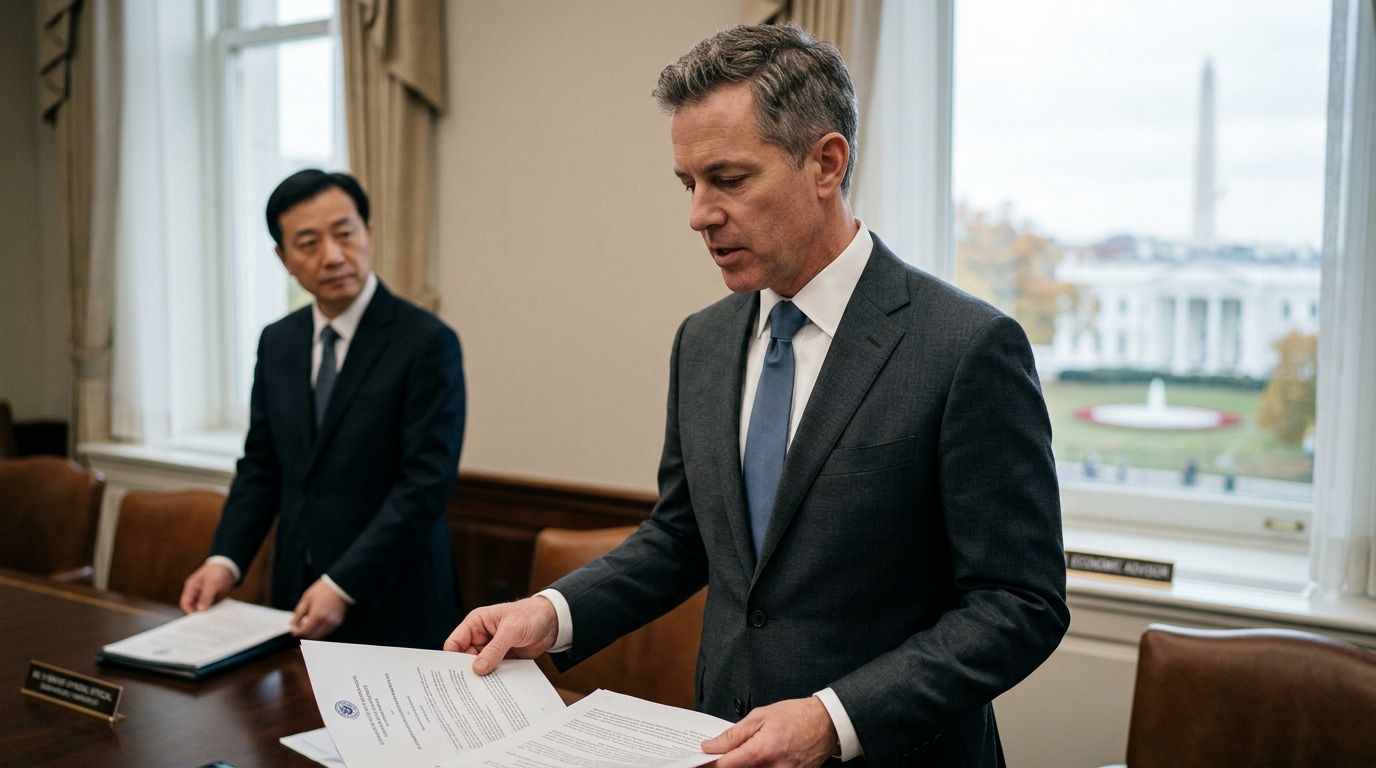
The only confirmed deliverable from the Trump-Xi summit arrived before the two men formally sat down. The announcement came after Bessent and China’s Vice Premier He Lifeng held a meeting ahead of Xi’s Washington state visit, and within minutes of Xi’s plane touching down, Bessent was on Fox News confirming the extension. “We will extend what we call the ‘Busan Agreement’ – the economic détente between the two countries that was scheduled to end on Nov. 10 – that is going to be extended until Jan. 10,” Bessent said.
Two months. Not six. Not twelve. The length is the message.
Ahead of this week’s summit, many had expected the truce would be extended by six months or longer. That consensus was wrong, and the gap between expectation and outcome is exactly the debate professional investors are now having. The two-month extension “suggests to me the U.S. is unsatisfied with China’s offers and wants to keep the heat on,” said Scott Kennedy of the Center for Strategic and International Studies. Bessent made the same point in plainer language: “There are some deliverables that have not been perfect on the Chinese side, so we also want to see, now that we’ve sat down and told them our expectations, if over the coming months they can be more fulsome in enacting the agreement.”
The Bull Case: Compression Forces a Deal
Yun Sun, a senior fellow at the Stimson Center, said the short extension suggests the two nations were planning a wider deal. The logic is clean: a January 10 deadline keeps the pressure on into the run-up to the G20 in Miami in mid-December and keeps Xi’s attendance at that summit a live incentive. The two leaders could also meet alongside an APEC meeting in Shenzhen in November and the G20 summit in Miami in December. Under this reading, Bessent is running a short leash precisely because he expects to need it as a prod, not because a broader agreement is out of reach.
Bessent also indicated that there could be further announcements in coming days from the Chinese delegation, including agreements to buy more American agricultural products and potential deals in the financial services sector. The bulls point to that pipeline as evidence the architecture of a larger deal is already being assembled.
The Bear Case: A Cliff Is a Cliff
The skeptics read the same two months and reach the opposite conclusion. The U.S. believes China has not fully honoured its rare earth export commitments, and those concerns remain part of negotiations over preserving the Busan deal. That is not a technicality. Since November 2025, China has suspended, not repealed, a set of expanded rare earth export controls, on a one-year timer that expires on Nov. 10, 2026. The Busan extension pushes the truce two months past that original date, but the underlying rules are still there, waiting. Jens Eskelund, president of the European Chamber of Commerce in China, pointed out that simply extending the trade truce does not address challenges companies face, including the lack of a standardized approach to apply for rare earth export licenses.
For Nvidia and AMD, the structure of the current arrangement adds its own pressure. Nvidia and AMD agreed to remit 15% of China AI chip sales revenue to the U.S. government in exchange for continued export licenses, an arrangement that survives only as long as Washington is willing to keep it open. Any movement on semiconductor export controls could shift valuations quickly. Tighter restrictions on chip exports to China would reinforce the U.S. advantage but could also trigger retaliatory measures affecting supply chains that American companies depend on.
What Investors Are Missing
Most of the debate has focused on whether January 10 is a real deadline or a rolling placeholder. The less-discussed risk sits inside the summit’s AI agenda. Washington continues to restrict China’s access to Nvidia’s most advanced AI chips and has accused Chinese AI companies of using “distillation” – training models on the output of more advanced U.S. systems – a claim Beijing rejects. Meanwhile, the clustering of Chinese domestic chip launches “gives Xi more examples to point to when arguing that U.S. restrictions can slow China’s technological development but have not prevented Chinese companies from finding alternative paths forward.”
That dynamic changes Nvidia’s China calculus whether a deal happens or not. If export controls loosen, Nvidia’s China revenue outlook re-rates upward. If they tighten, Beijing accelerates domestic substitution and Huawei gains share. The binary is real, and the next two months are when it resolves.
Stocks to Watch
Nvidia (NVDA) is the summit’s most direct equity proxy. Jensen Huang is among the executives expected to attend the state dinner for Xi on Thursday, a signal Washington views chip licensing as a live negotiating variable rather than settled policy.
MP Materials (MP) sits at the other end of the leverage. The company already runs its core rare-earths business domestically and reported positive adjusted earnings in the first quarter of 2026, which gives it a functioning operating base outside China. The rare earth listing does, however, underline that flows are subject to tighter oversight, which could affect how quickly MP Materials can move material across borders. Every week the Busan extension holds is a week domestic supply chains have to harden.
GM (GM) and the automaker question are unresolved. GM CEO Mary Barra is among the attendees at Trump’s state dinner for Xi, with Chinese automaker U.S. market access still on the agenda. There remains strong unease around Chinese investment in the U.S., particularly Trump’s suggestion that he would not oppose Chinese automakers building cars in the country. More than two dozen Democratic lawmakers urged Trump to maintain an effective ban on Chinese automakers in the U.S. market.
FXI is the cleanest hedge on both sides of the two-month window. The extension removes a near-term cliff risk for Asian assets and should underpin the yuan and China-sensitive currencies such as the Australian dollar. But because an extension was widely signposted, the bigger swing factor is whether the summit produces the broader deal Beijing floated or simply a rollover. A rollover into January brings the cliff back, with less runway left.
Boeing (BA) is the sleeper name. U.S. Trade Representative Jamieson Greer said Monday that China was making progress on its May pledge to buy 200 Boeing jets, the American plane maker’s first major Chinese deal in nearly a decade. Progress on that order accelerating out of this week’s bilateral would be a material positive for BA’s order book entering 2027.
 Rising Star Stocks