
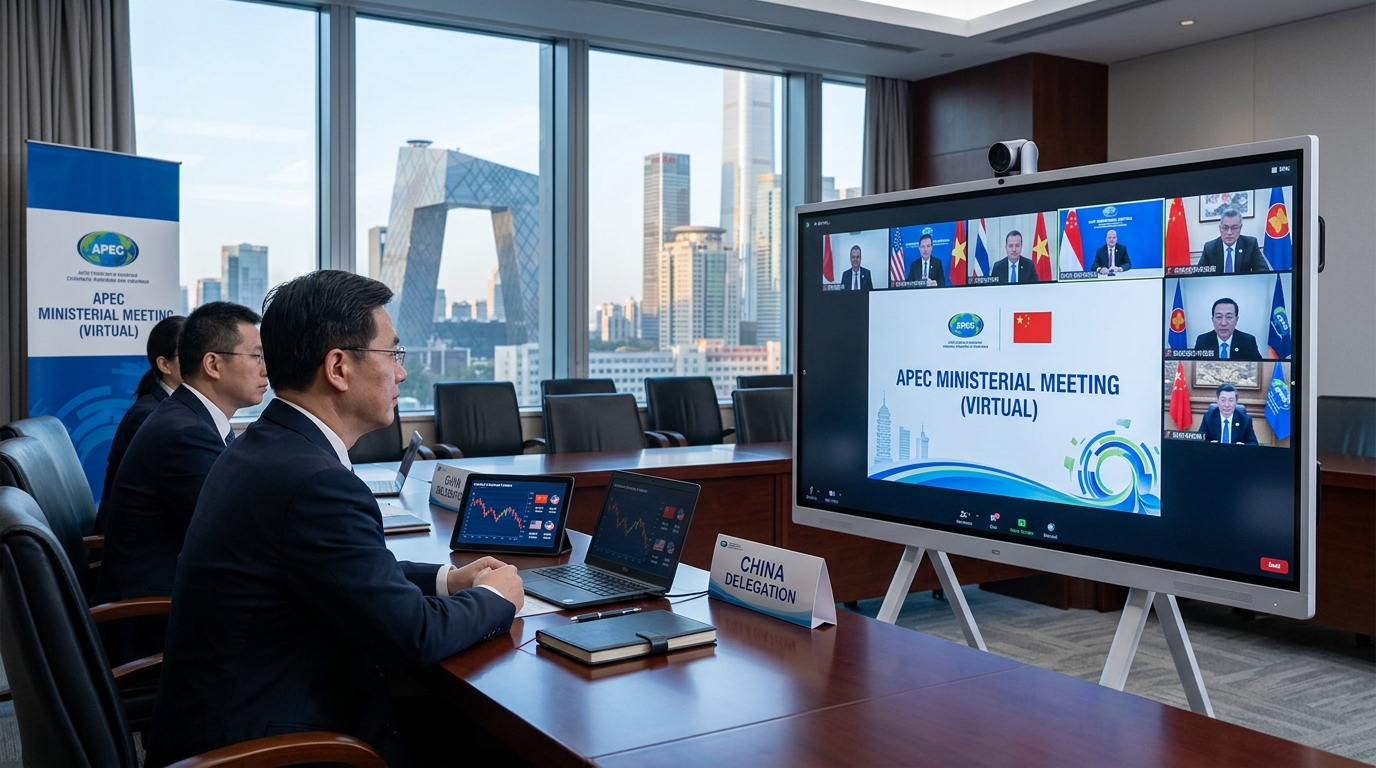
China’s proposal to shift a key APEC foreign and trade ministers’ meeting online should not be filed under diplomatic housekeeping. For investors holding Chinese equities through funds like FXI or KWEB, it is an early warning for the tariff deadline sitting on the calendar in January.
Here is the chain of events worth tracking. Xi Jinping paid a state visit to the United States from September 23 to 25, 2026. The optics were impressive: a 21-gun salute at Joint Base Andrews and a military flyover during the arrival ceremony, plus a visit to the National Archives to view the Constitution and other founding documents. The substance was thinner. Trump hosted Xi with ceremony at Joint Base Andrews, but public reporting suggested limited concrete outcomes.
The South China Morning Post reported this week that Beijing had wanted considerably more. Chinese officials had floated the idea of Xi holding a dialogue with U.S. business leaders or speaking to students at a top university in Washington or New York. None of those pitches made it to the itinerary of what ended up being a tightly choreographed visit. Differences between Washington and Beijing over potential investment announcements also created roadblocks for a Chinese business delegation expected to accompany Xi.
Now comes the APEC signal. The 33rd APEC Economic Leaders’ Meeting is scheduled for Shenzhen on November 18 and 19, 2026, accompanied by related ministerial events. China as host had every reason to want that ministerial session to be a high-profile in-person gathering, a diplomatic showcase for Xi’s home turf. Reuters reported on October 6, 2026 that plans are moving toward holding the ministers’ meeting online.
When a host economy tries to demote its own pre-summit ministerial to a video call, it is usually because one or more major delegations will not show up in person, or because the political temperature makes a face-to-face session more costly than useful. Either reading points to the same conclusion: U.S.-China diplomacy is operating under considerably more friction than the September pageantry suggested.
That friction matters directly to investors because of what follows on the trade calendar. Washington confirmed the U.S.-China trade truce will run until January 10, 2027, extending tariff relief beyond the original November expiry. Treasury Secretary Scott Bessent framed it as buying time “to see what we can do on the economic front.” Significant strategic friction points, including rare earth mineral supply chains and technology regulations, continue to weigh on global market sentiment. The window between now and January 10 runs directly through the Shenzhen summit. If ministers cannot agree to be in the same room ahead of it, a productive leaders’ meeting becomes harder to script.
What This Means for FXI and KWEB
FXI, which tracks the FTSE China 50 Index, is down about 12% year-to-date in 2026; KWEB, which tracks the CSI Overseas China Internet Index, is down about 28% over the same period. Both funds have been pulled in opposite directions all year by the oscillating read on U.S.-China relations. The September visit gave them a brief lift, with KWEB up roughly 3% and FXI up roughly 2% on October 5, 2026. That kind of single-session move can unwind just as quickly if the diplomatic backdrop deteriorates before January.
FXI’s heavier weighting toward Chinese financials and state enterprises makes it somewhat less exposed to technology-specific regulatory risk than KWEB, which concentrates in internet and platform companies that feel any export-control tightening most acutely. Investors in either fund holding a long-term position on Chinese growth are not necessarily wrong to hold it. But sizing that position without accounting for the January deadline is a choice, not a default.
The Wealth-Building Takeaway
Diplomatic signals precede market moves, often by weeks. A host economy quietly pushing its own ministerial meeting online is not a neutral logistical decision: it reflects a political calculation. Those calculations around tariff cliffs tend to resolve sharply in one direction or the other. Investors who build wealth through uncertainty like this are those who stay engaged without overconcentrating, and who let the diplomacy clarify before adding meaningfully to positions that hinge on it.
 Rising Star Stocks