Editor’s Note: Our friend Louis Navellier has been a guest at Mar-a-Lago, President Trump’s private residence in Palm Beach, Florida. He’s one of America’s top tech investors. He called Nvidia before it went up 44,000%. He predicted the dot-com crash and the 2020 Covid rally. And now he’s revealing what he calls the biggest prediction of his 40-year career.
Dear Reader,
Deep in the Appalachian Mountains of Tennessee…
Behind a triple layer of razor wire and a security clearance most Americans will never hold…
Something extraordinary is being built.
You won’t hear about it on CNBC.
The Wall Street Journal hasn’t touched it.
And yet, according to my research, what’s happening inside this facility will trigger one of the most dramatic wealth transfers in American history.
I know this place well.
It’s the same “secret city” that gave America the atom bomb.
The same lab that turned the tide of World War II.
And now – under a directive from President Trump himself – America’s top scientists and engineers have returned to this site for one purpose:
To build a new category of AI computer so powerful…
Trump himself compared it to a Manhattan Project – but for AI.
And I believe – based on months of exhaustive research – this device is going online very soon.
When it does, it won’t just leapfrog ChatGPT, Gemini, and even Elon’s Grok…
It will accelerate AI breakthroughs by 360-fold.
Breakthroughs that used to take five years? They’ll happen in five days.
And that will trigger a $100 trillion reset of the AI markets – the biggest disruption I’ve seen in my 40-year career.
I called Nvidia before it went up 44,000%. Apple before it went up 36,000%. Microsoft before its 60,800% rise.
But nothing in four decades has looked quite like this opportunity.
I’ve prepared a full presentation with the details – including the name and ticker of the one company I believe is best positioned to profit.
Click here to watch it now, free of charge.
Regards,
Louis Navellier
Senior Quantitative Investment Analyst, InvestorPlace
P.S. The “secret city” in Tennessee has been off-limits to the public for decades. But what’s being built there right now is about to become impossible to ignore. When Trump flips the “on switch,” I expect it to trigger a $100 trillion shock to the AI markets. Go here for full details – including the ticker symbol – before this video comes down.
DraftKings Has a Second Business. Wall Street Just Valued It.
For the past year, prediction markets were the thing investors feared would break DraftKings. Platforms like Kalshi and Polymarket exploded in volume during the 2026 FIFA World Cup, and the question on every analyst’s model was simple: were sports bettors drifting away from licensed sportsbooks for good?
Bank of America’s answer, delivered Monday morning, was no. And the implications go well beyond a relief rally.
The Number Nobody Had Put on Paper
BofA estimates prediction markets could generate about $400 million in fees for DraftKings in 2027, with a further $200 million to $400 million potentially coming from market-making activities. That is the first time a major Wall Street firm has attached a combined dollar figure to what DraftKings’ prediction exchange, DKeX, could actually be worth as a standalone revenue line. The range is wide, but the floor alone changes the conversation.
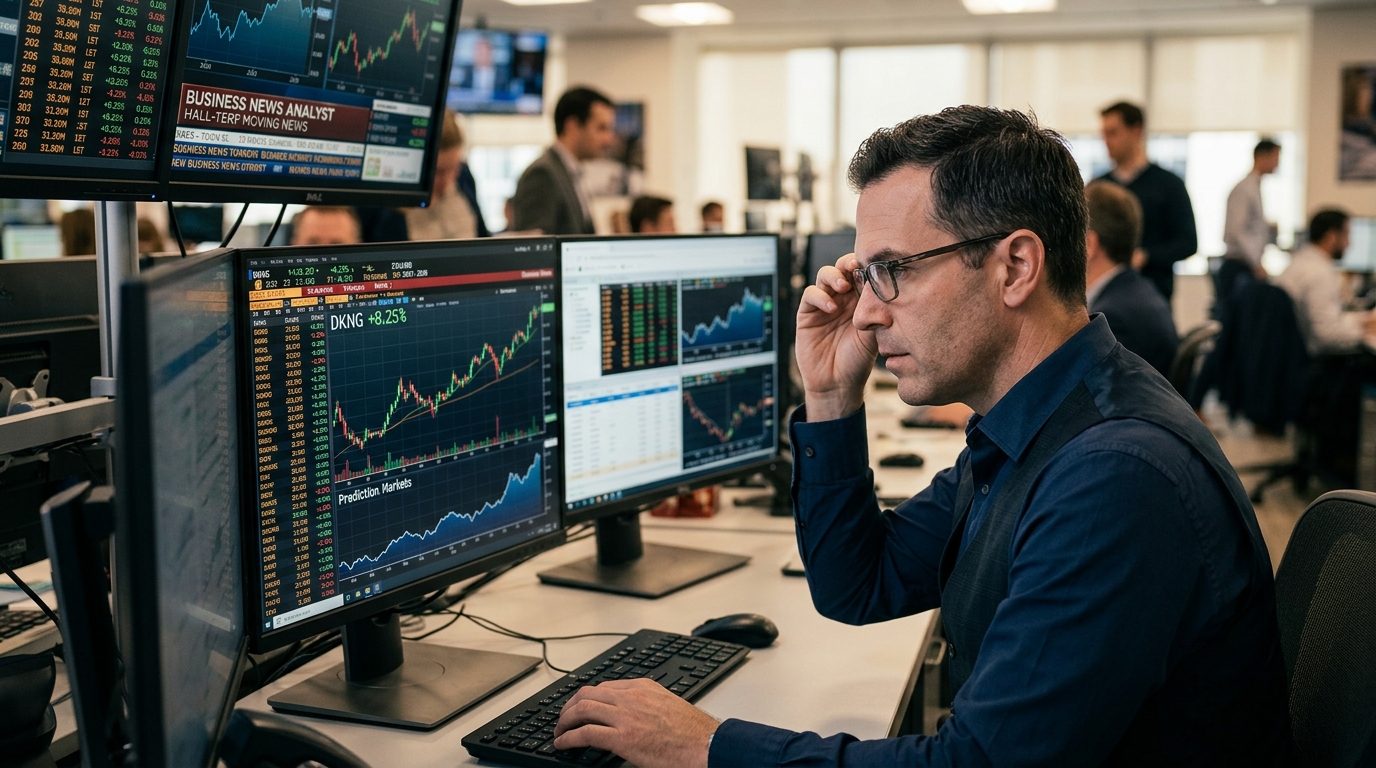
DraftKings shares rose about 8% on the upgrade. Bank of America shifted the stock from Neutral to Buy, predicting DraftKings has upside ahead after falling more than 40% this year. The $27 price target implies roughly 35% to 40% potential upside, based on where the stock traded around $19 to $20 heading into the week.
Third-Largest, Almost by Accident
Here is what makes the BofA thesis interesting: DraftKings did not set out to be a prediction market company. It built a sportsbook. Then, as Kalshi and Polymarket grabbed headlines, it launched DKeX to hedge its competitive position. DKeX has been cited as a No. 3 player by volume behind Polymarket and Kalshi, and it achieved that while offering sports event contracts in only 18 states.
Prediction-market activity has not grown as fast as sportsbook handle, and DraftKings has rebuilt its lead in active users, suggesting many bettors still prefer the sportsbook experience. That is the cannibalization fear quietly deflating. The customers are not leaving. Some are doing both.
BofA analysts Julie Hoover and Shaun Kelley noted that prevailing trends indicate core sports betting customers continue to favor the sports betting experience, alleviating concerns that the market could significantly erode demand for traditional sports betting.
A Win Either Way
The structural argument here is more durable than it looks. BofA said DraftKings would benefit if prediction markets were ultimately restricted, because removing the regulatory uncertainty would eliminate an overhang on the company’s valuation. If they are not restricted, DraftKings collects fees and market-making spread from a product that scales on existing infrastructure.
BofA raised its 2027 adjusted EBITDA estimate to $1.15 billion from $1.05 billion, reflecting stronger core trends and expected contributions from market-making. The bank expects DraftKings could guide to 2027 adjusted EBITDA of $1.0 billion to $1.2 billion.
DraftKings CEO Jason Robins framed it plainly in May: “Our core business is strong, and profitability is inflecting. That gives us the firepower to press our advantage in Predictions.”
Risks Worth Watching
State gaming regulators and federal commodities authorities have not settled how event contracts on sporting outcomes should be treated. That ambiguity cuts both ways, as noted above, but it also means volumes could compress quickly if rulings go the wrong direction. In the NFL’s opening week, Needham said Kalshi handled 76% of sports prediction-market trading volume, while DraftKings’ DKeX accounted for about 3%. Volume market share and fee revenue share are very different numbers, and DraftKings still has ground to close on the leader.
The analyst said stronger cost discipline will be needed to support higher margins beyond 2027.
The Bigger Picture
Prediction markets are becoming a genuine asset class. The volumes are real, the fee economics are attractive, and DraftKings is one of three scaled players in a market that is still being defined by regulators. Most of the attention goes to pure-play platforms. The case BofA is making is that the market is sleeping on the operator that already has tens of millions of registered users and a large sportsbook business.
At roughly $19 to $20 a share heading into this week, DKNG may be worth keeping on the radar as the regulatory picture clears and 2027 EBITDA estimates begin to firm up.
 Rising Star Stocks