
October 15, 2026
Bonus Content: When a Grid Spike Ruins a Glucose Sensor, Flywheels Win
If you haven’t downloaded my “Top 10 Stocks to Buy This Quarter” report yet, please do it right now.
It takes about five seconds.
And once we swap in next quarter’s list, this edition won’t be available anymore.
Good Trading,
Bill Poulos
p.s. It’s the 10 stocks we like most right now, each one explained in plain English. Normally $29.97. Free here.
When a Grid Spike Ruins a Glucose Sensor, Flywheels Win
There is a number worth holding in mind before the Q3 earnings call Abbott Laboratories has scheduled for October 21: seven deaths potentially associated with incorrect low glucose readings tied to one production line among several that make Libre 3 and Libre 3 Plus sensors.
The FDA’s subsequent warning letter, dated January 23, 2026, followed an October 2025 inspection and alleged systemic manufacturing and quality-control failures at Abbott Diabetes Care’s Alameda, California facility. The production line in question served the FreeStyle Libre 3, Abbott’s flagship continuous glucose monitor, a sensor worn on the skin, read by a phone, trusted with life-and-death dosing decisions. The company said it identified and resolved the cause of the issue, which related to one production line. Still, the episode made explicit something that gets little attention in medical device earnings discussions: precision biosensor manufacturing is extraordinarily sensitive to process interruption. A voltage spike mid-cycle. A momentary frequency deviation. A blink of power the grid supplies without warning. Any of these can corrupt a calibration run, a chemical deposition step, or a quality-check sequence that, once spoiled, cannot simply be restarted.
Abbott is not alone. The same fragility lives in semiconductor fabs, pharmaceutical fill-and-finish lines, and high-speed diagnostic instrument assembly globally.
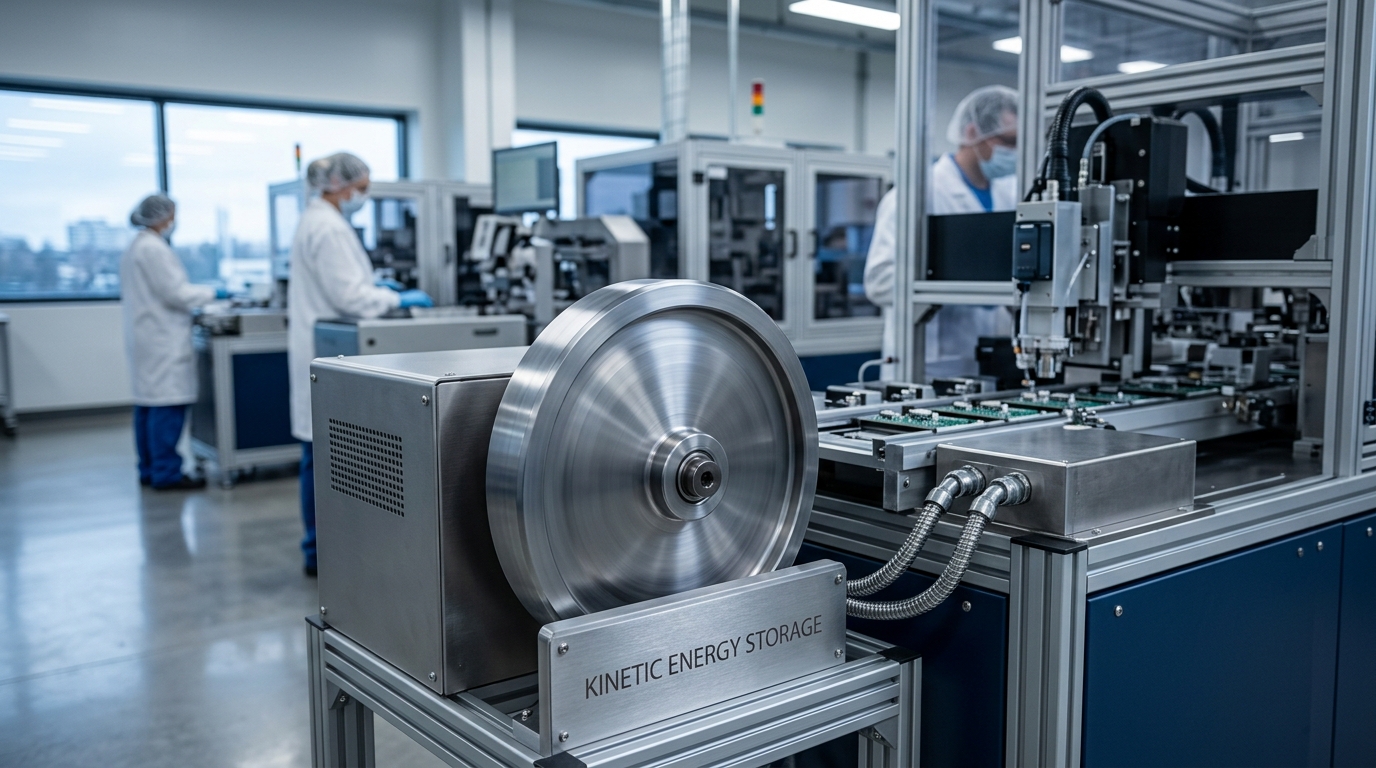
That is the industrial logic behind a market that now sits at roughly $580.8 million in 2026 and is projected to nearly double to $1.1546 billion by 2033. Flywheel energy storage, kinetic storage, stores energy mechanically in a spinning rotor and can deliver power in under 100 milliseconds. No chemistry degrades. No coolant leaks. One estimate puts a well-maintained flywheel’s useful life at 30 years with minimal capacity loss, which changes asset planning for any facility running continuous production.
Flywheels are not displacing lithium-ion. The more precise picture is a division of labor: flywheels absorb the instantaneous shock of a grid spike, while batteries and longer-duration storage handle sustained discharge. Beacon Energy’s COO described the AI data center version of this problem in July 2026 as “hammer blows” of load steps in milliseconds. Factory lines making medical sensors face the same physics, at smaller scale but higher consequence.
Abbott’s Q2 2026 results, reported July 16, showed medical device segment sales up 9% to $5.85 billion. Analysts currently expect roughly $13.0 billion in Q3 revenue and $1.42 in adjusted EPS. The Exact Sciences acquisition adds debt and amortization pressure, and ABT has lagged the S&P 500 by a wide margin over the past year. At roughly $105, the stock trades near a P/E of 34, not cheap for a company navigating FDA scrutiny on one of its highest-growth product lines.
What the kinetic storage connection offers is a frame, not a direct revenue stream. Abbott does not sell flywheels. The point is structural: the companies that build facilities where precision is non-negotiable are the demand signal for an energy storage technology that Wall Street still treats as obscure. Every new Libre manufacturing line Abbott opens, including the facility launched in Kilkenny, Ireland, that is expected to employ more than 800 people, represents another installation where uninterrupted, clean power is an operating requirement, not a preference.
The infrastructure layer enabling that requirement is already being priced into industrial earnings. Power management and electrical systems suppliers are reporting record revenue growth as precision facilities multiply and grid-to-rack reliability becomes a capital spending priority.
The grid will keep spiking. The devices being made inside those factories will keep requiring that it not.
 Rising Star Stocks