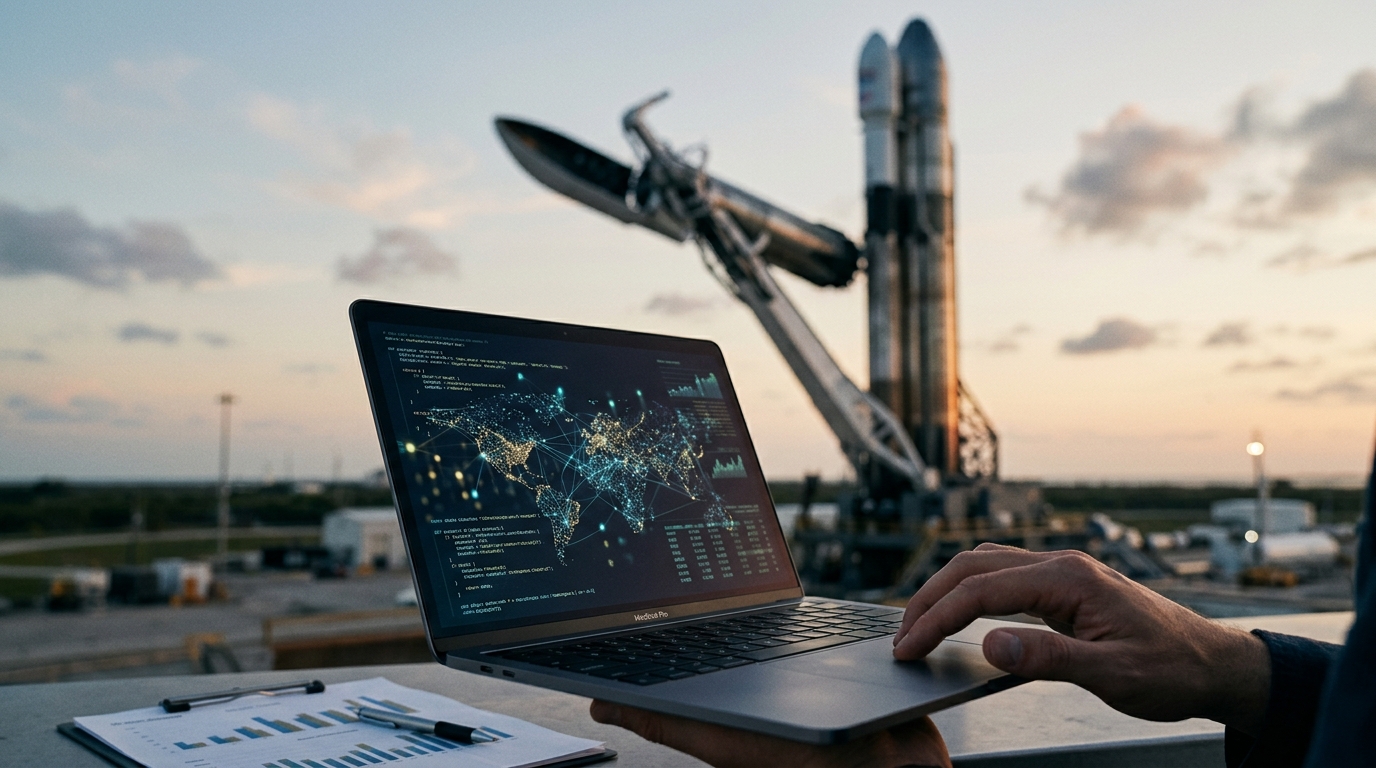
Four months after listing at $135 a share, SpaceX reports third-quarter results Tuesday evening with its stock sitting near $146 and its market cap hovering around $1.92 trillion. The share price is almost beside the point. The real question hanging over the October 20 release is structural: does SPCX belong in your portfolio as a launch business, a satellite internet company, or a vertically integrated AI infrastructure play? Tuesday’s numbers will sharpen that debate, and not gently.
In Q2 2026, SpaceX spent $18.4 billion on capital expenditures, with $15.8 billion allocated to the build-out of AI compute infrastructure. Against that backdrop, the quarter produced revenue of $7.8 billion and a net loss of $541 million. That is not a typo: the company deployed more than twice its quarterly revenue in a single spending category, in a single quarter, and still beat consensus by nearly $1 billion on the top line.
What the Segments Actually Say
Connectivity was the only segment to generate an operating profit, at $1.66 billion for the quarter, as Starlink subscribers reached 12 million, doubling from a year earlier. That business is real and growing. The AI segment brought in $2.56 billion in revenue, up 247% year-over-year, but posted an operating loss of $1.26 billion. Rockets, meanwhile, contributed $962 million in space segment revenue. In other words, the launch business that gave SpaceX its reputation is now the smallest revenue line.
Into Tuesday’s report comes a fresh piece of news that makes the AI spending question even more urgent. The Financial Times reported last week that Apollo Global Management and several banks are in discussions with SpaceX to help facilitate a purchase of about $40 billion worth of Nvidia GPUs. The report said SpaceX is seeking roughly $10 billion through bank loans and another $30 billion via investment-grade debt, with Apollo expected to lead and Pimco among lenders in discussions, and that the transaction is expected to close in 2027.
The Launch Business Is Not Standing Still Either
On the rocket side, the regulatory calendar has moved. The FAA issued a Notice of Intent to prepare a Programmatic Environmental Impact Statement on SpaceX’s proposal to increase Starship-Super Heavy operations at Starbase, including up to 456 launches and 912 annual landings, marking an expansion from the 25 annual Starship/Super Heavy orbital launches previously authorized under the existing license modification process. Public scoping meetings begin November 17. The full Environmental Impact Statement process typically takes longer than a standard review, meaning the path to FAA approval for the full 456-launch cadence could extend well into 2027 or beyond. That cadence is aspirational for now, but the filing signals where management intends to take launch economics.
What the Bulls and Bears Are Arguing
Morgan Stanley maintained an Overweight rating and $300 price target, with a sum-of-the-parts valuation assigning $8 to Space, $118 to Connectivity, $8 to X and Grok, and $165 to Enterprise AI. Enterprise AI accounts for 55% of the target price, making it the largest value driver. Analyst Adam Jonas described SpaceX as “cheap and getting cheaper” on a growth-adjusted basis.
Evercore ISI forecasts SpaceX will exit 2026 with annualized revenue near $104 billion. Evercore expects SpaceX to reach roughly 2.3 gigawatts of compute capacity by year-end, above consensus. The bear case writes itself: a company spending at a $73 billion annualized capex rate, seeking another $40 billion in debt financing, with a large block of employee and early-investor shares expected to become eligible for sale after the IPO lockup expires later this month.
What Investors Should Watch Tuesday
Three numbers matter most. First, AI segment operating losses: did they narrow from Q2’s $1.26 billion, and did CFO Bret Johnsen’s claim that new compute spending pays back in under a year begin to show up in the margin line? Second, Starlink subscriber growth and average revenue per user, which fell roughly 23% year-over-year in the figures SpaceX included in its IPO prospectus as the company expanded internationally. Third, any updated guidance on capex trajectory, because the Q2 annualized rate of $73.5 billion was already above full-year consensus heading into that quarter.
SpaceX built its reputation by landing rockets no one thought could land. The harder trick, and the one Tuesday’s report will begin to grade, is whether a company burning through AI capital at this pace can bend its cost curve before the market loses patience.
 Rising Star Stocks