
November 8, 2026
Bonus Content: Sea Limited Has Been Cut in Half. Its $148 Average Target Hasn’t Moved.
The Shocking Truth about the AI Bubble
In just 48 hours, a tidal wave of bad news battered AI stocks:
- Chip giant Intel dropped 29%…
- Google had its worst day ever, losing $500 billion in value…
- And tech stocks plummeted by more than $1 trillion in one trading day…
That’s more than $153 billion vaporized each hour!
Top internet news site Drudge Report had this headline screaming at the top of the page…
“$10 trillion ‘AI Boom” starting to crack…”

So is the AI bubble finally bursting?
It sure as heck looks like it…
But here’s the shocking truth: it isn’t bursting for every stock.
On the same day Intel plunged 29%, the S&P 500 fell just 1.8%.
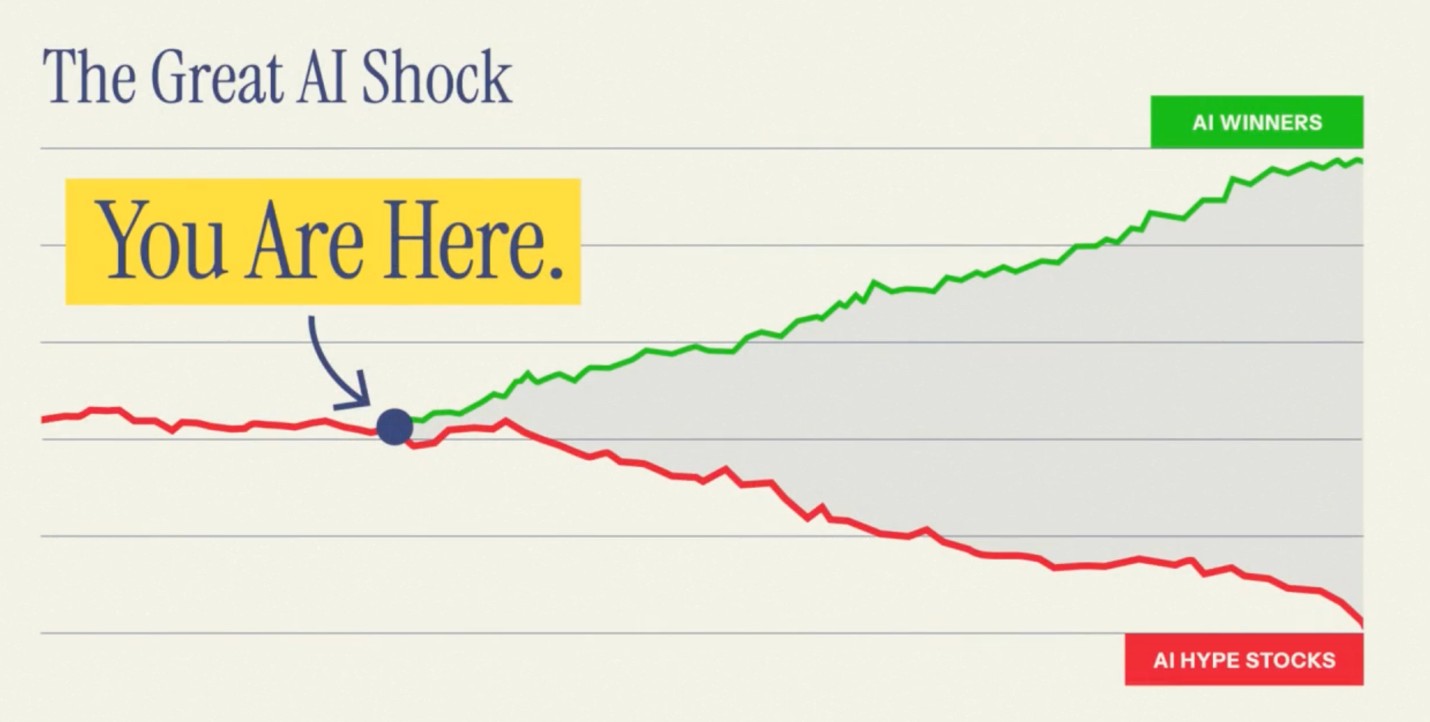
In other words, the stock market is splitting in two.
And the independent millionaire who recommended NVDA at $6 saw this coming.
He calls this stock market split the Great AI Shock.
On one side, the most hyped AI stocks could see a 77% meltdown…
On the other side, a little-known corner of AI that NVDA’s CEO calls a “once-in-a-generation opportunity” could produce triple digit gains over the coming months…
And the recent carnage is only the beginning – because the stock market split is just getting started…
If you own any AI stocks, you need to decide which side of the split you’re on…
And you need to decide soon.
See the full story here, including details on the #1 stock on the right side of the split.
Sea Limited Has Been Cut in Half. Its $148 Average Target Hasn’t Moved.

Southeast Asia’s most closely watched compounder has lost more than half its value in twelve months. The business underneath has not. That disconnect is what Tuesday’s earnings call needs to explain, one way or another.
Where the Stock Sits
Sea Limited closed Thursday at $75.73, pressed against a 52-week low of $71.53. The 52-week high was $159.09. That is a 52% decline over the past year for a company whose revenue grew 48.3% in a single quarter. The year-to-date drawdown sits at roughly 41%.
The selloff is not a valuation reset driven by deteriorating fundamentals in the way, say, a pure-play AI name might crater on a product miss. Sea grew. It missed earnings. Once. In Q1 2026, it reported $0.88 EPS against a $0.75 consensus. Then in Q2, it posted $0.70, well short of the $0.86 estimate. Revenue beat by roughly $670 million that same quarter, but the bottom line is what the market remembered.
What Reports Tuesday
Sea reports Q3 2026 results on Tuesday, November 10, before the market opens. Consensus EPS sits around $0.94 to $1.00 depending on the source, against $0.83 a year earlier. Revenue consensus is $8.08 billion. The implied one-day move in options is roughly 10 to 11%.
The EPS bar has risen despite a recent miss. That matters because the question is not whether Sea can grow. It demonstrably can. The question is whether growth translates into the per-share earnings the model requires to close the gap to the $148.25 average analyst price target still carried across 28 analysts, with J.P. Morgan maintaining Overweight and a $147 target as recently as October 28.
The Two Metrics That Carry Tuesday
Shopee’s take rate closed Q2 at 14.6%, up from 12.6% a year earlier. Advertising revenue grew more than 70% in that quarter, with the ad take rate widening by over 90 basis points. Management flagged that the pace of commission increases will likely slow, handing the take-rate story to advertising. So the question for Tuesday is whether the ad take rate is still compounding or whether Q2 was the high-water mark.
Monee is the second variable. The lending book closed June at $11.1 billion, up 62.5% year-over-year, while the 90-day non-performing loan ratio held at 1.0%. Active credit users exceeded 40 million. That is a remarkable quality-of-book statistic for a consumer lender growing at that pace. But provisions for credit losses jumped 71.5% in Q2, faster than loan book growth, and Brazil, Monee’s fastest-expanding market, carries a higher-risk borrower profile by management’s own description. Any deterioration in NPL ratios would quickly reframe Monee from a margin engine into a credit risk story.
The tension between a fast-growing lending book and rising provisions is not unique to Southeast Asia. SoFi has faced the same investor skepticism about whether accelerating member and loan growth can translate into durable bottom-line results.
There is a third variable worth noting. Sea said in October that it could pursue a public listing for Monee as a separate company. No valuation or timeline has been confirmed. A standalone Monee would give investors direct access to the lending business, which generated $1.4 billion in Q2 revenue, up 58.9% year-over-year. That unlocks optionality. It also raises the question of what Sea’s remaining businesses are worth once you strip out the fintech growth engine.
The Bull-Bear Gap
Analyst consensus is unusually wide. J.P. Morgan sits at $147, Barclays at $156, Benchmark at $175. DBS downgraded to Hold with an $85 target in October. New Street went to Hold with a $70 target. That is not a range; it is two entirely different views of the same company. Gross profit margin improved to 45.6% in Q2, which is a real data point. But the market is pricing near-term execution risk, not the five-year build.
The Position
A stock that halved while the underlying business grew nearly 50% is an interesting situation, but interesting is not the same as cheap without proof. Tuesday’s report is the proof opportunity. If Shopee’s take rate continues expanding and Monee’s NPL ratio holds at or below 1.0%, the gap between $76 and $148 becomes a conversation worth having. If provisions accelerate again and EPS misses a second consecutive quarter, the floor at $71.53 may not hold.
Sea is not a broken business. It may be a business that has not yet proven it can convert exceptional revenue growth into consistent bottom-line delivery. That is what Tuesday is for.
 Rising Star Stocks