October 24, 2026
Bonus Content: Jio Platforms Lists Wednesday. Institutions Were 70x In. Retail Barely Showed Up.
Dear Reader,
Amazon built a robot that can “feel.”
Not emotions like happiness or sadness.
It can work with items as different as socks and fragile electronics… while sensing contact and adjusting the force it applies.
As you probably know, Amazon has spent years automating its warehouses.
But strangely, this breakthrough has nothing to do with faster software, smarter chatbots, or more powerful AI chips.
Instead, it involves a new robot called Vulcan that can sense and handle objects using touch and force feedback.
Amazon says Vulcan can pick and stow approximately 75% of the item types inside its fulfillment centers.
Why does that matter?
Because it shows where AI may be headed next: out of computer screens and into the physical world.
See the story, including why physical AI could become the next major act of the AI boom.
|
Regards,
Matt McCall
Editor, McCall’s Innovation Report
P.S. Amazon says Vulcan can already pick and stow approximately 75% of the item types in its fulfillment centers. Click here to see why that matters for investors.
Jio Platforms Lists Wednesday. Institutions Were 70x In. Retail Barely Showed Up.
India’s capital markets have seen records fall regularly in recent years, but Wednesday’s event is different in kind. Jio Platforms, the Reliance Industries digital and telecom arm backed by Meta, Google, KKR and others, lists on the BSE and NSE on October 28, 2026 following the close of what is, in rupee terms, India’s largest initial public offering ever.
The Numbers Behind the Frenzy
The three-day subscription window ran October 21 to 23, 2026, and when the books closed, the issue was 22.19 times oversubscribed in total. That headline figure, though, obscures a split that matters enormously for anyone thinking about buying shares in the secondary market on Wednesday morning.
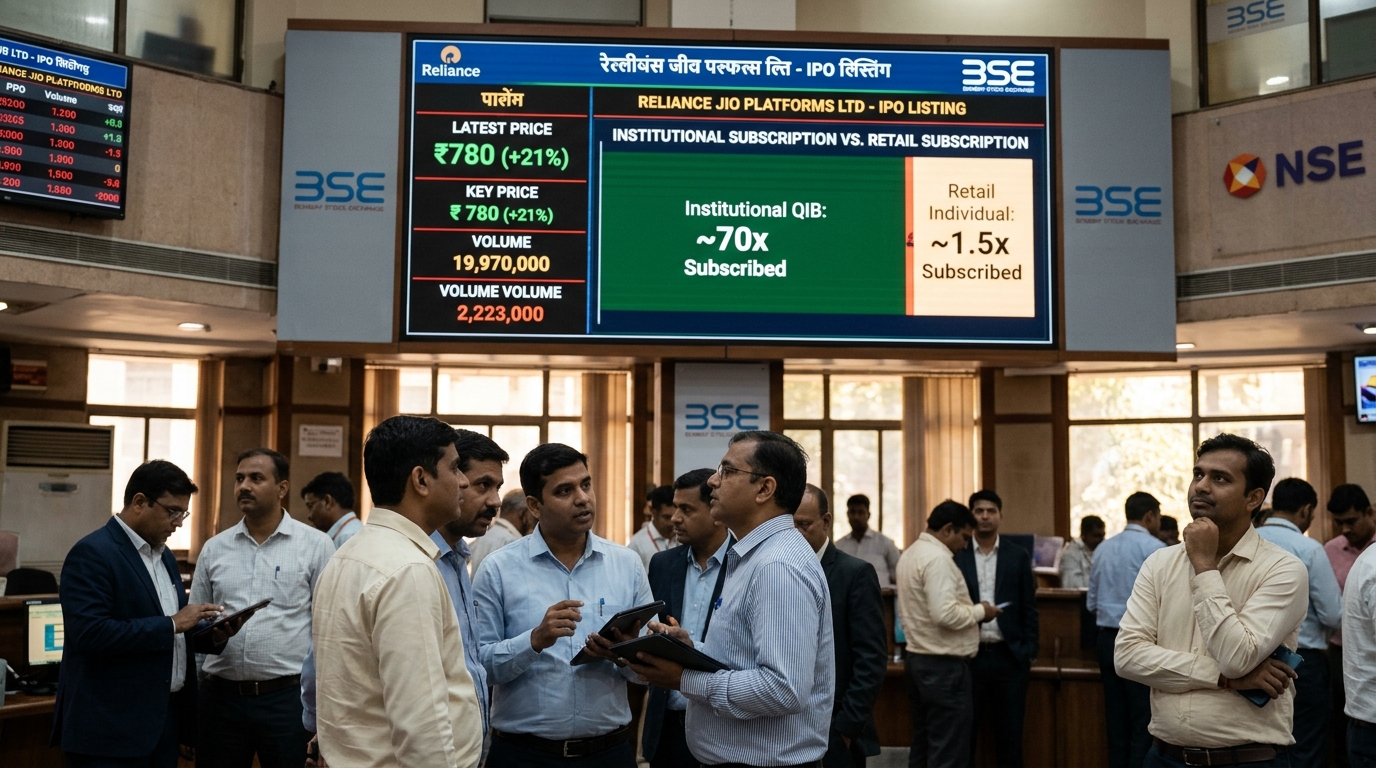
Qualified institutional buyers covered their allocation 70.55 times. Non-institutional investors came in at 14.00 times. Retail individual investors subscribed 2.72 times. The imbalance is not a rounding error. Institutions spent the final hours of Friday’s session flooding in orders; retail investors, meanwhile, barely cleared their category. That divergence is a signal worth reading carefully.
Allotment finalises on October 26, 2026, with shares credited to demat accounts on October 27, 2026 and listing on the BSE and NSE on October 28, 2026. Wednesday also happens to be the day the Federal Reserve delivers its rate decision and Microsoft and Alphabet report earnings, meaning global risk appetite will be shifting in real time while Jio’s opening price is being discovered.
What Jio Actually Is
The company combines a massive telecom subscriber base with digital services spanning broadband, entertainment, enterprise technology and cloud infrastructure. As of June 30, 2026, Jio had approximately 533.3 million customers.
The financial profile is genuinely substantial. FY2026 revenue reached ₹1,46,885 crore, up 14.6% year on year. EBITDA grew 18.8% to ₹76,255 crore and net profit rose to ₹30,049 crore. EBITDA margin expanded to 51.9% in FY2026. For a telecom operator at this scale, that is a genuinely strong operating position.
The offering is structured entirely as a fresh issue of up to 270 million equity shares with no offer-for-sale component, meaning all proceeds flow directly to the company, primarily to reduce debt at the subsidiary level. No existing shareholder is cashing out.
The Valuation Question That Retail Investors Inherit
Here is the core problem for anyone buying Wednesday on the open. At the upper IPO price of ₹1,119, Jio Platforms would carry an estimated post-issue market capitalisation of roughly ₹10.3 lakh crore.
On EV/EBITDA, Jio is often framed at roughly 10.5 to 10.9 times on forward estimates, with commentary that it sits at a premium to Bharti Airtel. That premium demands a growth story that has not yet shown up cleanly in reported numbers. Jio has assets in cloud, AI and digital services, but the prospectus does not isolate meaningful recurring software or AI profit pools at a scale that moves the needle.
Grey market data heading into listing pointed toward a roughly 21% premium over the issue price, with the unofficial indicative price around ₹1,359, based on a GMP of about ₹240 per share as of October 23, 2026. That premium can evaporate quickly if large allottees decide to book gains on day one.
The Imbalance and What It Means
When institutions subscribe at 70 times and retail at under 3 times, two things are likely true simultaneously: the institutional case is strong and well-researched, and the retail allocation is large enough that most applicants who wanted shares will receive them. That means there is no artificial scarcity to drive the opening price higher. Supply on listing day could be meaningful.
Return on average capital employed fell to 10.76% in FY2026 from 12.83% in FY2024. Earnings are growing, but the return generated relative to capital employed has weakened. That is worth keeping in mind when considering a price that already embeds optimism about spectrum monetisation and AI businesses that are still being built.
Worth Watching
Jio Platforms is a legitimate business, India’s largest digital network, and a structural beneficiary of the country’s continued data consumption growth. The IPO proceeds reduce debt rather than enrich sellers, and Reliance Industries’ stake is expected to be about 64.4% after the offer, alongside Google, Meta and KKR, aligning long-term incentives. The question is not whether Jio is a good company. It is whether the market on October 28, 2026, with institutions already holding most of their allocation and retail investors holding the rest, discovers a price that reflects that quality or one that immediately exceeds it. Anyone stepping in after day one may find they are paying for what institutions already priced in at 70 times.
 Rising Star Stocks