Dear Reader,
My name is Jeff Brown, founder and CEO of Brownstone Research.
And I want you to circle one date on your calendar…
That’s the day a tiny company could announce a huge supply deal with Elon Musk.
It’s a stock trading at under $1…
In an overlooked sector you’d never associate with tech.
But Musk’s robots, microchips and AI satellites all rely on it.

And on page 37 of the SpaceX IPO filing, Musk names this sector directly.
Why does that matter?
Because Musk raised $85.7 billion from the SpaceX IPO…
And a further $25 billion by selling bonds.
That money is about to flow downstream.
And when a Musk supplier in this sector announced a deal before…
The stock soared 395% in a single day.
That’s almost five times your money…
Before the sun goes down.
I recently sat down with an insider in this sector to talk about what could happen on November 11.
A man who once turned $13,140 of his own money…
Into around $1.85 million in under a year.
In our urgent strategy session, we reveal the name and ticker of a crucial Musk supplier…
Entirely for free.
But once November 11 arrives, this opportunity could be gone.
Click here to watch the strategy session before November 11.
We have so much to look forward to,
Jeff Brown
Founder & CEO, Brownstone Research
Rocket Lab’s Real Business Is Not the Rocket
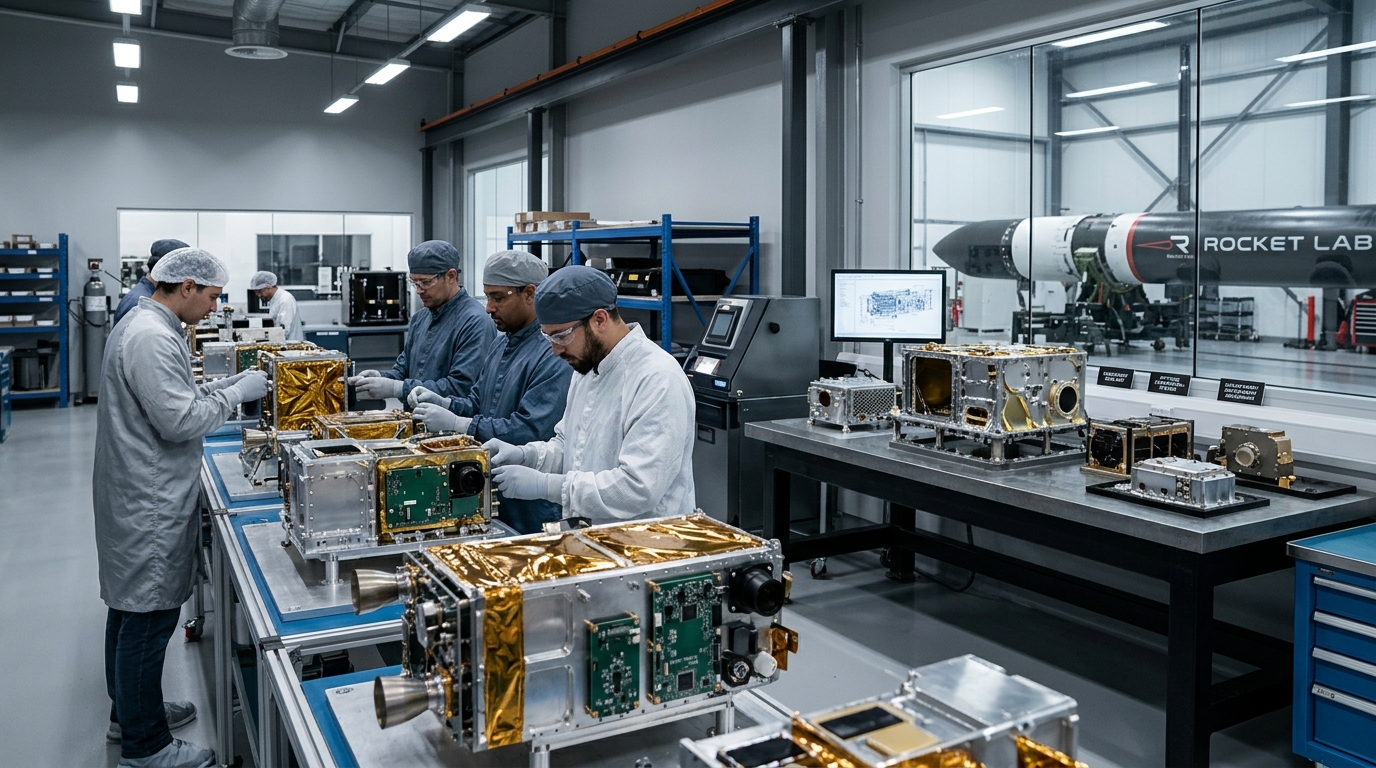
When most people think of Rocket Lab, they picture an Electron rocket lifting off from Mahia Peninsula. That picture is becoming misleading. The company reporting Q3 results tonight after the bell has quietly built a manufacturing and components business that is eclipsing its own launch segment in both revenue and profit.
The Margin Engine Nobody Talks About
In Q2 2026, Space Systems generated $189.48 million in revenue against $44.59 million from Launch Services. More telling: Space Systems produced about $65.47 million in gross profit that quarter, more than three times the $19.11 million from launches. The components side of that division, covering solar cells, propulsion hardware, separation systems, and optical terminals, carries gross margins that management has previously described as in some cases above 60% and even into the 70% range. When those components mix heavily into a quarter, they pull the whole segment’s margin well above what satellite manufacturing alone would yield.
That margin mix is exactly what investors should be watching in tonight’s call. Rocket Lab guided Q3 GAAP gross margins of 29%–31%, a step down from Q2’s 36.1%, reflecting a heavier weighting toward large fixed-price satellite contracts. The question is whether quick-turn components revenue, which management has said can arrive outside the visible 12-month backlog conversion window, offsets that pressure.
A Backlog That Keeps Growing
The $2.36 billion backlog Rocket Lab carried into Q3 grew 137% year over year. Space Systems held $1.42 billion of that figure, with Launch Services accounting for $940.2 million. Since the Q2 close, the company entered into a $266 million Space Force suborbital launch contract and announced a $397 million Space Force satellite contract with options, suggesting Q3 backlog could move higher still.
The pattern of launch revenue being overshadowed by other segments is not unique to Rocket Lab. SpaceX’s own rocket business has become its smallest revenue line as connectivity and AI infrastructure pull ahead.
Analysts expect Q3 revenue of roughly $257 million, a 65% year-over-year jump, with the consensus EPS loss pegged around seven cents per share. The company’s own guidance midpoint of $257.5 million sits almost exactly in line with that estimate, leaving little room for a soft beat to satisfy a market that watched shares fall about 12% on November 5 alone after the Neutron delay story resurfaced.
The Iridium Variable
Hovering over all of this is the pending $8 billion Iridium acquisition. Iridium stockholders approved the deal on September 24, 2026, with about 99.6% of votes cast in favor. Rocket Lab completed a $1.94 billion at-the-market equity offering to fund the cash portion and expects the transaction to close in mid-2027. Iridium adds more than 2.5 million subscribers across government, defense, aviation, and maritime markets, along with globally coordinated L-band spectrum that Rocket Lab could not have assembled itself in less than a decade.
The deal also adds meaningful recurring cash flow to a business still running at an adjusted EBITDA loss. That changes the financial character of RKLB considerably: manufacturing contracts burn cash in the near term, but satellite service subscriptions generate it steadily. Investors discounting the stock today on profitability timelines may be anchoring to a Rocket Lab that will not exist in 18 months.
The gap between backlog and earnings conversion is a recurring tension across defense and space contractors. Large fixed-price government contracts at RTX and Lockheed show how record order books can mask near-term margin pressure.
The Risk Worth Naming
None of this is riskless. The ATM offering diluted the share count meaningfully. Neutron, now pushed to 2027 after inspections found voids in a first-stage tank dome, remains a cost center. And guided GAAP gross margins in the high-20s to low-30s percent range are well below the 43% non-GAAP gross margin the company reported in Q1. If satellite manufacturing contracts continue to dominate the mix without enough components revenue to lift them, margin disappointments could compound an already pressured share price.
Tonight’s call may not resolve the Neutron debate. But it could answer the more immediate question: whether the manufacturing and components business beneath the rocket is profitable enough, consistent enough, and growing fast enough to carry the company through the wait.
 Rising Star Stocks